Wild garlic butter recipe.
That’s probably what you typed a few seconds ago, right?
Now let me guess what’s happening in your head. You’re thinking, “I just need something quick. Maybe spread it on bread, maybe melt it over steak… nothing complicated.”
Yeah, I’ve been there. Actually, scratch that. I’m there every spring.
The first time I made wild garlic butter, I didn’t overthink it. I had a handful of fresh wild garlic leaves, slightly damp from washing, and a block of butter sitting out because I forgot to put it back in the fridge. Not exactly a chef moment. But then that smell hit. Sharp, green, almost… alive. It didn’t smell like regular garlic. It felt fresher, softer, like something you shouldn’t waste.
And that’s where this whole thing starts to shift.
Because making a proper wild garlic butter recipe isn’t really about following steps. It’s more like catching a moment. The kind of moment where you realize that simple ingredients can actually taste… better than they should.
You might be wondering right now, “Is it really that different from normal garlic butter?”
Honestly, yes. And no.
Yes, because fresh wild garlic leaves bring this almost herbal, slightly sweet intensity that regular garlic just can’t replicate. No, because at the end of the day, it’s still butter. Still simple. Still forgiving. And that’s kind of the point.
What I’ve noticed, though, is that most recipes online feel a bit… empty. They tell you what to do, but not why it works. Or worse, they overcomplicate something that should take five minutes max. And if you’re here, chances are you don’t want a lecture. You want something that works. Something you can actually use tonight.
So here’s what we’re going to do together.
We’ll start simple. Really simple. Just a few ingredients, no unnecessary steps. Then we’ll go deeper. I’ll show you how to tweak it, how to store it, how to use it in ways that make you pause for a second after the first bite.
And yeah, maybe that sounds a bit dramatic for butter.
But once you try it… you’ll get it.
So what makes this wild garlic butter recipe worth trying?
It comes down to a few things:
- It uses fresh wild garlic leaves, not dried shortcuts
- It’s a true 3 to 4 ingredients recipe, nothing hidden
- It’s ready in minutes but still feels like a gourmet butter recipe
- It works as a savory spread, a cooking base, or even a finishing touch
And maybe the biggest one, it actually fits real life. You can make it quickly, store it, freeze it, and come back to it when you need something that instantly upgrades a meal.
Table of Contents
Table of Contents
Wild Garlic Butter Recipe: A Sensory Spring Ritual You Didn’t Know You Needed
Wild garlic butter recipe.
Tu l’as probablement cherché sans trop réfléchir, juste avec l’idée de faire quelque chose de rapide. Peut-être pour du pain, peut-être pour accompagner un steak… rien de compliqué.
Mais laisse-moi te dire un truc, parce que j’ai eu exactement la même réflexion la première fois.
Je pensais juste faire un simple homemade garlic butter. Rien de spécial. Et puis j’ai coupé quelques fresh wild garlic leaves, encore légèrement humides, et l’odeur est montée d’un coup. Pas agressive comme l’ail classique. Plus verte, plus douce, presque… inattendue. À ce moment-là, je me suis dit, attends, il y a peut-être quelque chose ici.
Et c’est là que tout change un peu.
Parce que ce wild garlic butter recipe, ce n’est pas juste une autre recette rapide. C’est ce genre de truc que tu fais une fois, un peu par curiosité, et ensuite tu te retrouves à le refaire chaque printemps sans vraiment y penser. Un peu comme un réflexe.
Tu te poses peut-être la question maintenant. Est-ce que ça vaut vraiment le coup par rapport à un garlic herb butter recipe classique ?
Honnêtement… oui, mais pas pour les raisons que tu crois.
Ce n’est pas plus compliqué. Ce n’est pas plus technique. C’est juste plus vivant en goût. Le wild garlic apporte une profondeur différente, presque herbacée, qui transforme complètement un simple butter spread en quelque chose de beaucoup plus riche.
Et en même temps, restons honnêtes. Ça reste du beurre. Ça doit rester simple. Si ça devient compliqué, c’est qu’on s’est perdu quelque part.
This wild garlic butter recipe is incredibly easy to make at home.
Why this wild garlic butter recipe feels different
Ce qui fait la différence ici, ce n’est pas une technique secrète. C’est plutôt une combinaison de choses simples :
- l’utilisation de fresh wild garlic au bon moment de la saison
- une base de unsalted butter recipe qui laisse vraiment les arômes s’exprimer
- un équilibre naturel entre richesse et fraîcheur
- une préparation rapide qui garde le côté simple homemade recipe
Et peut-être le plus important, ça s’adapte à ton rythme. Tu peux le faire en 3 minutes ou prendre un peu plus de temps pour le peaufiner.
What you can expect from this recipe
Avant d’aller plus loin, voilà ce que tu vas vraiment obtenir :
- un aromatic butter spread avec un goût marqué mais équilibré
- une recette prête en quelques minutes
- quelque chose que tu peux utiliser sur du pain, avec steak, ou même avec pasta et potatoes
- une base que tu peux transformer facilement en flavored butter recipe plus complexe
Et si tu es en train de te dire, est-ce que ça va vraiment changer quelque chose dans mes plats…
Oui. C’est exactement le genre de petit détail qui fait toute la différence.
What Is Wild Garlic? Fresh Wild Garlic Leaves Explained and How to Identify It
Before you even start making a wild garlic butter recipe, there’s a small moment of doubt that usually happens.
You look at these long green leaves and think… is this really it? Or am I about to cook something I shouldn’t?
I had the exact same hesitation the first time. I remember holding a bunch of wild garlic leaves and thinking they looked almost too simple to matter. No dramatic shape, no intense color. Just… green leaves. But the second you crush one between your fingers, everything becomes obvious.
That smell. Clean, garlicky, slightly sweet. No confusion anymore.
What is wild garlic really
Wild garlic, often called ramsons, is a spring herb that grows naturally in forests and shaded areas. It’s one of those ingredients that feels almost hidden, like you only notice it if you’re actually looking for it.
The leaves are soft, flat, and bright green. Unlike regular garlic, you don’t use bulbs here. It’s all about the leaves. And that’s important, because the flavor is completely different.
Instead of being sharp or overpowering, wild garlic has a more balanced taste. It sits somewhere between garlic and fresh herbs. That’s why it works so well in a garlic herb butter recipe or any kind of infused butter.
And maybe this is just me, but it feels more seasonal. Like something you’re not supposed to have all year.
How to identify wild garlic safely
Now this part matters more than people think.
Because wild garlic has a few lookalikes. And yeah, some of them are not something you want in your kitchen.
Here’s the simplest way to recognize edible wild garlic:
- crush a leaf gently and smell it, it should clearly smell like garlic
- leaves grow individually from the ground, not in clusters
- texture is soft, not waxy or thick
- color is a vibrant, fresh green
If there’s no garlic smell, don’t use it. That’s the easiest rule to remember.
A lot of people skip this step because they assume all green leaves in spring are safe. They’re not. And honestly, it’s not worth the risk.
When and where to find fresh wild garlic
Wild garlic season is short. That’s part of what makes this whole wild garlic butter recipe feel a bit special.
You’ll usually find it in early to mid spring, often in:
- damp woodlands
- shaded forest areas
- near rivers or streams
It tends to grow in clusters, almost like a green carpet. Once you spot it, you start seeing it everywhere.
And here’s something I didn’t expect at first. The younger leaves taste better. More tender, more aromatic. The older ones can get slightly tougher and less balanced in flavor.
So if you’re picking or buying fresh wild garlic leaves, go for the smaller, softer ones.
Why This Easy Wild Garlic Butter Recipe Works So Well and Why Most Recipes Don’t
There’s something a bit frustrating about trying a wild garlic butter recipe for the first time and thinking… that’s it?
You followed the steps, used the right ingredients, and yet the result feels flat. Not bad, just… underwhelming.
I’ve had that happen. More than once, actually.
And for a while, I thought maybe I was expecting too much from something this simple. But then I realized the issue wasn’t the idea of a wild garlic butter recipe. It was how most recipes approach it. They treat it like a basic mix instead of something that relies heavily on balance and timing.
Why This Wild Garlic Butter Recipe Is So Popular
This wild garlic butter recipe has become a favorite because it combines simplicity and flavor. Many home cooks love this wild garlic butter recipe for its quick preparation and rich taste.
The real reason this wild garlic butter recipe works
What makes a good wild garlic butter recipe stand out isn’t complexity. It’s restraint.
Most people either overpower the wild garlic or don’t use enough of it. There’s rarely a middle ground. And that’s where things start to fall apart.
Here’s what actually makes the difference:
- the ratio between butter and fresh wild garlic leaves
- the texture of the butter before mixing, not too hard, not melted
- how finely the leaves are chopped, which affects flavor distribution
- the moment you taste and adjust, not after everything is already mixed
It sounds simple, but each of these small details changes the final result more than you’d expect.
And maybe this is just me, but I’ve noticed something else. The best homemade garlic butter always feels slightly imperfect. Not overly smooth, not overly blended. A bit rustic. A bit uneven. That’s where the character comes from.
Where most garlic herb butter recipes go wrong
A lot of garlic herb butter recipe variations try to improve things by adding more. More herbs, more seasoning, more extras.
But instead of enhancing the flavor, it often just muddies it.
Common mistakes you’ll see:
- adding too many herbs and losing the wild garlic identity
- using salted butter without adjusting the seasoning
- blending too much until it becomes a uniform paste
- skipping acidity completely, which makes the butter feel heavy
And the result? A flavored butter recipe that technically works… but doesn’t really stand out.
There’s also this tendency to rush. Which is ironic, because this is supposed to be a quick recipe. But rushing doesn’t mean ignoring texture, balance, or taste.
One of the best things about this wild garlic butter recipe is its versatility.
The balance between simplicity and flavor
A good wild garlic butter recipe sits in a strange place. It’s simple, but not careless. Quick, but not rushed.
You’re working with a rich buttery base and a fresh, slightly sharp ingredient. The goal isn’t to make one dominate the other. It’s to let them meet somewhere in the middle.
That’s why even a small adjustment, like adding a bit of lemon zest butter or keeping the mixture slightly textured, can completely change how it feels when you taste it.
And once you get that balance right, you start to understand why this works so well as a compound butter recipe. It’s flexible, adaptable, and surprisingly forgiving once you know what matters.
Ingredients for the Best Wild Garlic Compound Butter with Simple Fresh Ingredients
This is usually the part where people expect a long list.
But honestly… this is where the wild garlic butter recipe becomes almost suspiciously simple.
I remember double-checking the first time. Like, that’s it? No hidden ingredient? No extra step I’m missing?
Nope. Just a few things. And somehow, that’s exactly why it works.
The essential ingredients for a wild garlic butter recipe
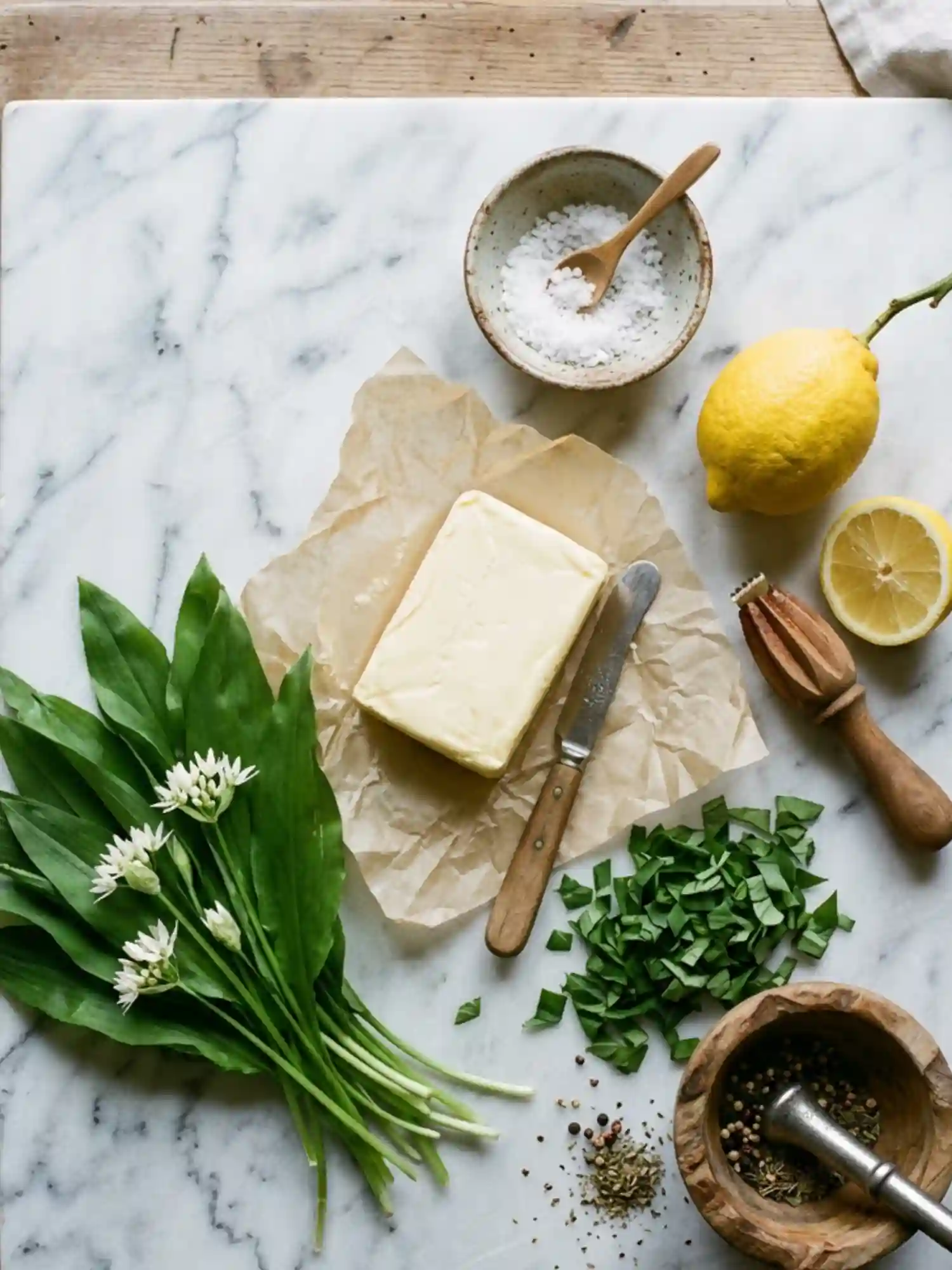
At its core, a good wild garlic butter recipe relies on just 3 to 4 ingredients. Nothing more, nothing you don’t actually need.
Here’s your base:
- fresh wild garlic leaves, finely chopped
- unsalted butter, softened
- salt, adjusted to taste
- optional lemon zest for a slight lift
That’s it.
And before you think about adding anything else, it’s worth pausing here. Because this exact combination already gives you a rich buttery flavor, a fresh herbal edge, and a balanced savory spread that works in almost any context.
The unsalted butter part matters more than people think. It gives you full control. If you start with salted butter, you’re already limiting your ability to adjust the final taste.
Choosing the right fresh wild garlic leaves
Not all wild garlic leaves behave the same way in a wild garlic butter recipe.
Some are more intense, others softer. And if you’ve ever tasted a batch that felt too strong or slightly bitter, chances are it came from older leaves.
Here’s what to look for:
- young, tender leaves with a soft texture
- a strong but clean garlic smell
- no dryness or yellowing on the edges
And here’s something I didn’t expect at first. The way you cut the leaves changes everything.
If you chop them too roughly, you get uneven bursts of flavor. Too fine, and you lose some of that fresh character. There’s a middle ground that feels more natural, slightly rustic, not overly processed.
If you’ve never tried a wild garlic butter recipe before, this is the perfect place to start.
Optional additions that actually make sense
Now, this is where it gets tempting to experiment.
And yes, you can turn this into a garlic herb butter or a more complex infused butter. But not everything improves the result.
If you want to build on your wild garlic butter recipe, these are the additions that actually work:
- lemon zest butter for a fresh, slightly sharp contrast
- parsley herb butter for added green depth
- a touch of black pepper for subtle heat
What you’ll notice is that all of these stay in the same flavor direction. Nothing fights the wild garlic. Everything supports it.
That’s kind of the rule here. If an ingredient feels like it’s trying to take over, it probably doesn’t belong.
Understanding compound butter ingredients without overcomplicating
A lot of recipes use the term compound butter recipe as if it’s something technical.
But when you break it down, it’s just butter mixed with flavor.
That’s it.
The difference between a basic homemade garlic butter and a proper flavored butter recipe is not the number of ingredients. It’s how well they work together.
And maybe this sounds a bit contradictory, but the more you try to improve this with extra elements, the easier it is to lose what made it good in the first place.
So if you’re hesitating right now, wondering if you should add more…
Start simple. You can always adjust later.
This wild garlic butter recipe works beautifully with simple ingredients.
How to Make Wild Garlic Butter Recipe Step by Step
Tu n’as besoin que de quelques minutes pour réussir ce wild garlic butter recipe. Mais la différence se joue dans les petits détails, pas dans la complexité.
Step 1: Soften the butter properly
Sors le beurre à l’avance et laisse-le à température ambiante. Il doit être souple mais pas fondu. Si tu appuies dessus, ton doigt doit s’enfoncer facilement. Évite le micro-ondes, ça casse la texture et donne un résultat trop gras.
Step 2: Prepare the fresh wild garlic leaves
Lave et sèche soigneusement les feuilles. Retire les tiges épaisses si nécessaire puis hache finement. Ne cherche pas à faire une purée, garde une texture légère pour un résultat plus naturel et agréable en bouche.
Step 3: Mix butter and wild garlic
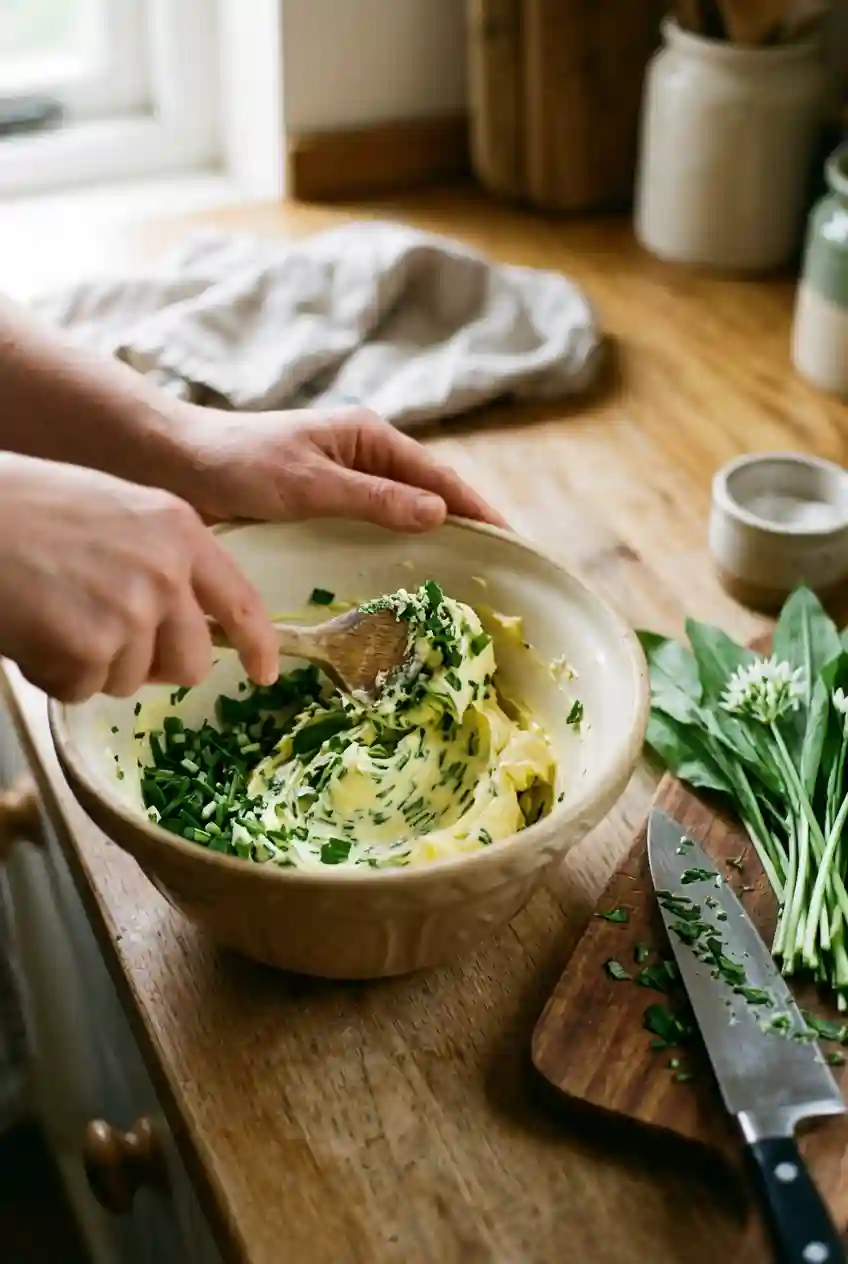
Dans un bol, ajoute le beurre ramolli et les feuilles de wild garlic. Mélange avec une fourchette ou une spatule jusqu’à obtenir une répartition homogène. Prends ton temps, c’est ce qui donne un bon équilibre final.
Step 4: Season and adjust
Ajoute une pincée de sel, mélange puis goûte. Ajuste progressivement avec un peu plus de sel, éventuellement du poivre ou une touche de lemon zest pour apporter de la fraîcheur. C’est ici que le goût se construit vraiment.
Step 5: Shape or use immediately
Tu peux l’utiliser directement comme butter spread, ou le déposer sur du papier cuisson, former un boudin et le placer au frigo pendant 1 à 2 heures. Une fois ferme, il sera facile à trancher pour steak, bread ou potatoes.
Step 6: Let it rest for better flavor
Même si tu peux l’utiliser tout de suite, laisser reposer améliore le résultat. Les saveurs se développent, la texture devient plus stable et l’ensemble est plus harmonieux.
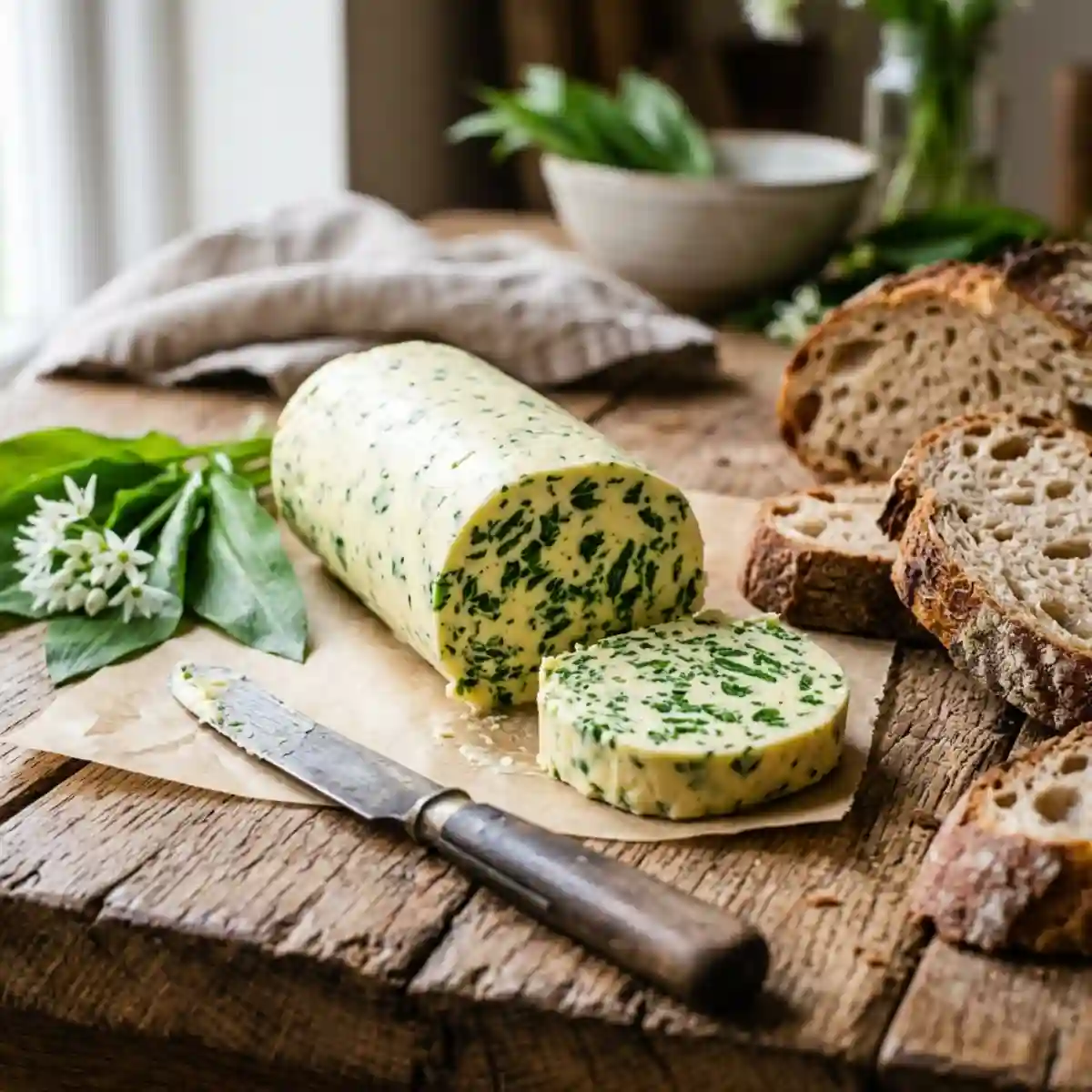

Wild Garlic Butter Recipe
Ingredients
Method
- Soften the butter at room temperature until spreadable.
- Wash, dry, and finely chop the wild garlic leaves.
- In a bowl, mix butter and chopped leaves until evenly combined.
- Add salt and optional lemon zest, then mix again.
- Taste and adjust seasoning if needed.
- Shape into a log or use immediately as a spread.
- Chill for 1 hour if you want a firmer texture.
Notes
| Nutrient | Per 1 tablespoon |
| Calories | 100 kcal |
| Fat | 11 g |
| Saturated Fat | 7 g |
| Carbohydrates | 0.5 g |
| Protein | 0.2 g |
| Sodium | 80–120 mg |
- Use fresh wild garlic for best flavor
- Do not overmix to keep a natural texture
- Let it rest for better taste development
3-Minute Version vs Gourmet Version Which Wild Garlic Butter Should You Make
There’s always that moment where you hesitate a bit.
Do you keep it quick and practical, or do you slow down and try to make something that feels a bit more… refined?
I’ve gone both ways with this wild garlic butter recipe. Sometimes I just want something ready in minutes. Other times, I lean into it a bit more, almost treating it like a small kitchen ritual.
And honestly, neither is better. It just depends on what you need right now.
The 3-minute wild garlic butter recipe version
This is the version you make when you’re hungry and don’t want to think too much.
You take your softened butter, mix in finely chopped fresh wild garlic leaves, add a pinch of salt, maybe a touch of lemon zest if you have it nearby, and that’s it. Done.
No shaping, no resting time, no adjustments beyond a quick taste.
What you get is:
- a quick and satisfying butter spread
- a strong fresh garlic flavor
- something ready to use immediately on bread or toast
It’s not perfect, but it works. And sometimes, that’s exactly what you want.
The gourmet wild garlic butter approach
Now this is where things shift slightly.
You’re still using the same base wild garlic butter recipe, but you slow things down just enough to refine it.
You pay attention to:
- chopping the leaves more evenly
- balancing the salt carefully
- adding subtle extras like lemon zest or herbs
- shaping the butter into a log and letting it rest
You might even taste, adjust, and taste again. Not because you have to, but because you want to get it just right.
The result feels different:
- smoother, more balanced flavor
- better texture when sliced or melted
- a more refined aromatic butter spread
- something that feels closer to a gourmet butter recipe
So which one should you choose
If you’re just trying this for the first time, go with the quick version. It helps you understand the flavor without overthinking anything.
But if you already like the taste and want to push it further, the slower version is where things become more interesting.
And here’s the part I didn’t expect at first. Once you try the more refined version of a wild garlic butter recipe, it’s actually hard to go back to the rushed one. Not because it’s bad, but because you start noticing what’s missing.
Still, there are days where quick wins matter more than perfect results.
Flavor Variations Lemon Garlic Herb and Infused Butter Ideas
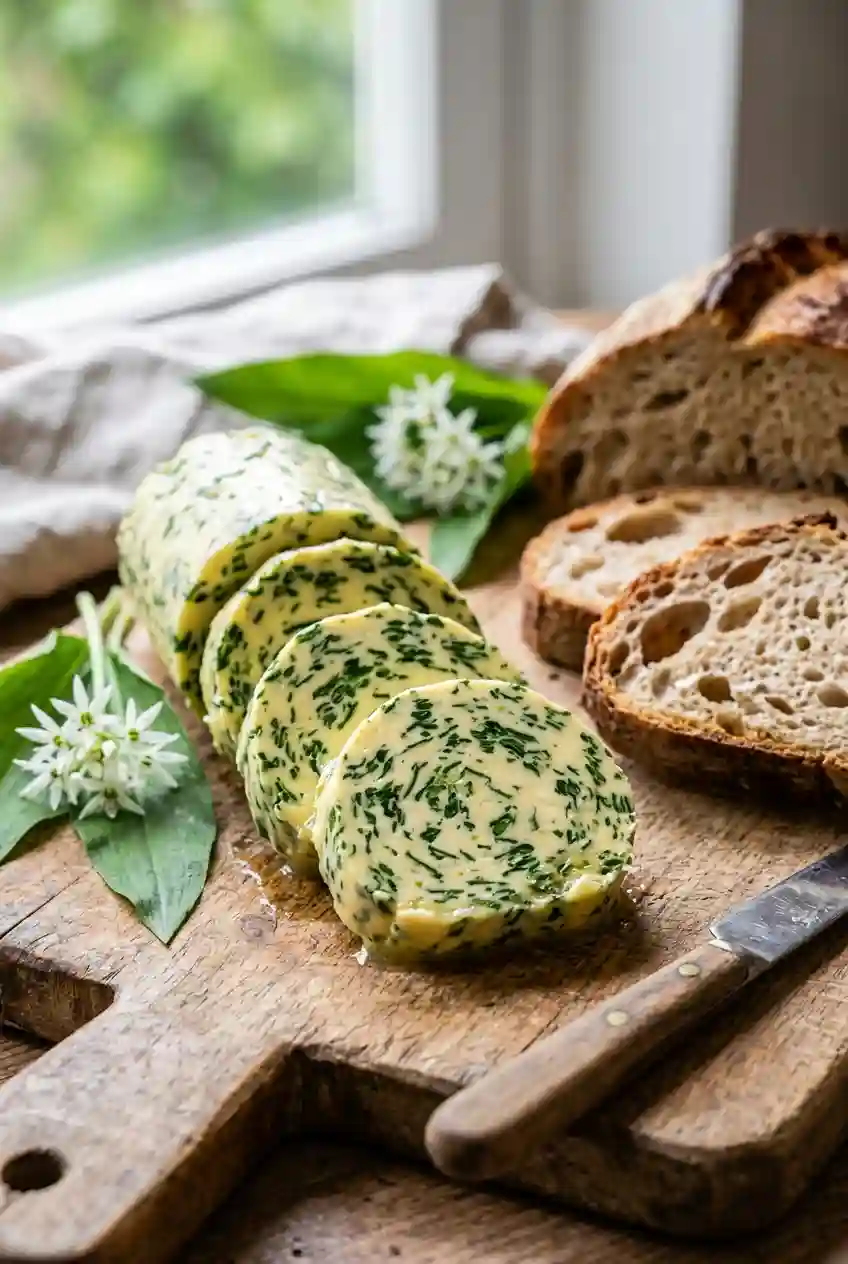
This is usually the moment where you start thinking… okay, I’ve got the base wild garlic butter recipe, but can I make it even better?
The answer is yes. But not by adding everything at once.
I’ve made that mistake before. Adding more herbs, more seasoning, more “ideas”… and somehow ending up with something less interesting. A good wild garlic butter recipe improves with small, intentional changes, not big ones.
Lemon wild garlic butter for a fresh lift
If your butter feels a bit too rich or heavy, lemon is the easiest way to fix that.
Adding lemon zest will:
- lighten the overall flavor
- balance the richness of the butter
- enhance the natural freshness of the wild garlic
The key is subtlety. You don’t want a lemon butter. You want a gentle brightness that sits in the background without taking over.
This version works really well on warm bread, fish, or even simple vegetables.
Garlic herb butter for added depth
At some point, you might feel like the flavor is a bit too simple. Not boring, just missing something.
That’s where turning your base into a garlic herb butter makes sense.
You can add:
- parsley for a soft, green freshness
- chives for a mild onion note
- a touch of thyme for more depth
But here’s the balance. The wild garlic should stay dominant. If the other herbs take over, the whole identity of your wild garlic butter recipe starts to fade.
Infused butter for a more refined version
If you want to go a bit further, you can approach this as an infused butter.
Instead of just mixing, you’re layering flavors more carefully.
You might try:
- a small amount of roasted garlic for sweetness
- a hint of black pepper or chili
- very light seasoning adjustments
This gives your butter a more refined, almost gourmet feel without making it complicated.
And interestingly, this is where a simple wild garlic butter recipe can start to feel like something you’d get in a restaurant.
Knowing when to stop
This is probably the hardest part.
A good wild garlic butter recipe doesn’t need much to work. In fact, the best versions are often the simplest ones.
So if you find yourself adding more and more ingredients, trying to improve it… pause.
You might already be at the point where it’s exactly right.
How to Use Wild Garlic Butter Recipe with Steak Bread Pasta and More
This is where things start to get a bit addictive.
Because once you’ve made a batch, you don’t just use it once and forget about it. You start looking at everything on your plate thinking… would this be better with a bit of that on top?
Short answer, most of the time, yes.
I didn’t expect that at first. I thought this wild garlic butter recipe would just be a nice extra for bread. But it quickly turns into something you use across multiple meals without even planning it.
On bread for the simplest and most satisfying use
Let’s start with the obvious one.
Fresh bread, slightly warm, with a layer of this butter melting into it. That alone is enough. No need to complicate anything.
It works especially well with:
- toasted bread or baguette
- rustic sourdough
- warm flatbread
The butter melts just enough to soak into the surface while keeping some texture. It’s simple, but it hits every time.
And honestly, this is probably the easiest way to understand why this wild garlic butter recipe is worth making in the first place.
With steak for a rich finishing touch
Now this is where things feel a bit more elevated.
Adding a slice of butter on top of a hot steak creates that slow melt effect. It mixes with the juices and forms a natural sauce without any extra work.
What makes it work:
- the richness of the butter enhances the meat
- the wild garlic adds freshness that cuts through the fat
- the heat releases all the aromas at once
It’s one of those small upgrades that makes a big difference. You don’t change the dish, you just improve it.
With pasta potatoes and everyday meals
This is the part most people underestimate.
A simple wild garlic butter recipe can transform very basic dishes into something much more satisfying.
Try it with:
- pasta instead of a heavy sauce
- boiled or roasted potatoes
- steamed vegetables
- rice or grains
It melts into everything and creates a quick, flavorful coating. No extra sauces needed.
And maybe this is just me, but this is where it becomes the most useful. Not for special meals, but for everyday cooking.
As a base for sauces and dips
You can also push it a bit further.
Melt the butter and use it as a base for:
- a quick garlic butter dipping sauce
- a drizzle over grilled vegetables
- a finishing touch on cooked dishes
At this point, it stops being just a spread and becomes more of a homemade condiment you keep coming back to.
And that’s the thing. Once you get used to having it in your fridge, you start using it without thinking.
Mistakes to Avoid When Making Wild Garlic Butter Recipe Most People Miss This
This is the part people usually skip.
Not intentionally… but because it feels too simple to mess up.
And yet, this is exactly where things go wrong.
I’ve had batches that tasted dull, others too strong, and a few that just felt off without really knowing why. It took a bit of trial and error to realize that a good wild garlic butter recipe isn’t about doing more. It’s about avoiding a few key mistakes.
Using the wrong butter texture
This is probably the most common issue.
If your butter is too hard, it won’t mix properly. You’ll end up with uneven distribution and pockets of flavor. If it’s too soft or melted, the texture becomes greasy and loses structure.
What you want is:
- soft, spreadable butter
- not shiny or melted
- easy to mix but still holding shape
It sounds basic, but it directly affects the final result.
Overpowering the wild garlic flavor
It’s easy to assume more is better. More leaves, more intensity, more flavor.
But with this kind of recipe, balance matters more than strength.
Too much wild garlic can make the butter taste harsh instead of fresh. On the other hand, too little makes it forgettable.
A well-balanced wild garlic butter recipe should feel:
- aromatic but not aggressive
- fresh but still rich
- noticeable without dominating everything
If you taste it and something feels “too much”, it probably is.
Adding too many ingredients
This is where things quietly fall apart.
You start with a simple idea, then think… maybe I’ll add herbs, spices, extras. And before you know it, the butter loses its identity.
Common overcomplications include:
- mixing too many herbs together
- adding strong spices that mask the main flavor
- trying to turn it into something overly complex
A good wild garlic butter recipe doesn’t need much. The more you add, the more careful you need to be.
Not tasting and adjusting
This one is subtle, but important.
A lot of people mix everything once and stop there. No second taste, no adjustment.
But small changes matter:
- a pinch more salt can transform the flavor
- a slight balance adjustment can fix heaviness
- tasting early helps you avoid overdoing anything
It’s a quick step, but it makes a big difference.
Skipping resting time completely
You can use the butter immediately, and it will be fine.
But if you skip resting every time, you’re missing something.
When the butter sits for a while:
- flavors blend more naturally
- texture becomes firmer and easier to use
- overall taste feels more complete
It’s not mandatory, but once you notice the difference, it’s hard to ignore.
How to Store Wild Garlic Butter Recipe and Freeze It the Right Way
This is usually where people hesitate a bit.
You’ve made your wild garlic butter recipe, maybe even a really good one… and now you’re thinking, okay, how do I keep this without ruining it?
I’ve made the mistake of just leaving it in the fridge, uncovered, thinking it would be fine. It wasn’t. The texture changed, the flavor faded, and it picked up other smells.
So yeah, storage matters more than it seems.
Storing in the fridge for short term use
If you plan to use your butter within a few days, the fridge is enough. But it has to be stored properly.
Here’s what works best:
- wrap it tightly in parchment paper or plastic wrap
- or place it in an airtight container
- keep it away from strong-smelling foods
Butter absorbs odors easily. That’s something you only notice after it’s too late.
When stored correctly, your wild garlic butter recipe will keep its flavor and texture without any issues.
Freezing for longer storage
This is where things get really practical.
If you’ve made a larger batch, freezing is honestly the best option. And the good news, it works very well.
To freeze properly:
- shape the butter into a log or small portions
- wrap it tightly
- place it in a freezer-safe bag or container
This way, you can take out only what you need.
And yes, if you’re wondering, can you freeze garlic butter? You absolutely can. A well-made wild garlic butter recipe holds up surprisingly well in the freezer.
Portioning for convenience
This is a small trick, but it changes everything.
Instead of freezing one big piece, divide it into smaller portions.
You can:
- slice it into rounds before freezing
- or freeze small spoon-sized amounts
That way, you don’t have to thaw everything just to use a little.
It makes the whole thing feel more like a ready-to-use homemade condiment rather than something you have to plan around.
Avoiding common storage mistakes
There are a few things that can ruin your butter without you realizing it.
Try to avoid:
- leaving it uncovered in the fridge
- storing it while still too soft or warm
- exposing it to air for too long
These small details affect both flavor and texture over time.
Make Ahead and Batch Prep Strategy for Wild Garlic Butter
C’est souvent là que le déclic se fait.
Au début, tu fais ce wild garlic butter recipe pour tester. Une fois. Peut-être deux.
Et puis sans vraiment t’en rendre compte, tu commences à te dire… ce serait pratique d’en avoir toujours sous la main.
Et c’est exactement ça l’idée ici.
Why making it ahead changes everything
Ce qui est surprenant, c’est que ce n’est pas juste une question de gain de temps.
Quand le beurre repose:
- les saveurs deviennent plus équilibrées
- le goût est moins “brut”, plus fondu
- la texture est plus stable et agréable
Du coup, un wild garlic butter recipe préparé à l’avance est souvent meilleur le lendemain. Pas toujours… mais souvent.
Keep it simple when batch prepping
Pas besoin de compliquer.
Si tu veux faire plus:
- double les quantités
- garde exactement les mêmes proportions
- mélange comme d’habitude
C’est tout.
Pas de technique spéciale, pas de piège. Juste un peu d’anticipation.
Et honnêtement, c’est le genre de recette où faire plus ne demande presque pas plus d’effort.
Portioning makes it actually useful
C’est un détail, mais il change tout.
Au lieu de garder un seul bloc, pense en portions:
- coupe en tranches avant de refroidir
- ou fais de petites portions directement
- garde-les prêtes à l’emploi
Comme ça, tu prends juste ce qu’il te faut. Pas plus.
Ça transforme complètement l’usage. Ce n’est plus “une recette à utiliser”, c’est quelque chose que tu intègres facilement dans tes repas.
How to keep it ready without losing quality
Si tu veux vraiment que ça devienne un réflexe, quelques habitudes suffisent:
- stocker correctement, toujours bien fermé
- garder une partie au frigo, le reste au congélateur
- éviter de sortir et remettre plusieurs fois
Rien de compliqué, mais ça évite les petites pertes de goût ou de texture.
How Long Does Wild Garlic Butter Last and How to Know When It’s Still Good
After making a batch, you’ll probably come back to it a few days later wondering if it’s still good.
A wild garlic butter recipe will usually last about 5 to 7 days in the fridge if stored properly. Keep it in an airtight container or tightly wrapped to preserve both flavor and texture.
If you want to keep it longer, freezing works very well. A wild garlic butter recipe can last up to 2 to 3 months in the freezer without losing much quality, especially if you’ve portioned it in advance.
How to tell if it’s still good
Instead of focusing only on time, check a few simple signs:
- the smell should stay fresh and slightly garlicky
- the color should remain even and green
- the texture should be smooth, not dry or grainy
If the aroma fades or feels off, it’s usually a sign it’s past its best.
Safe vs still enjoyable
Even if it hasn’t spoiled, the flavor can become weaker over time.
And honestly, with something this easy to make, it’s often better to prepare a fresh batch than use one that’s lost its freshness.
Wild Garlic Season Foraging and Safety Tips
Wild garlic is a true spring ingredient. You’ll usually find it between early March and May, depending on the region.
It grows in damp, shaded areas like forests or near rivers, often forming dense green patches.
Where to find wild garlic
Look for:
- woodland areas
- shaded paths
- moist soil environments
Once you spot it, it’s often everywhere around you.
How to forage safely
This part matters.
Wild garlic has lookalikes that are not safe to eat. The easiest way to check:
- crush a leaf, it must smell clearly like garlic
- leaves grow individually, not in clusters
- avoid anything without that strong garlic scent
If there’s any doubt, don’t use it.
Why freshness matters for your recipe
Fresh leaves make a huge difference in any wild garlic butter recipe.
- younger leaves are more tender
- flavor is brighter and less harsh
- texture blends better into butter
Other Ways to Use Fresh Wild Garlic
Once you’ve made this, you might start wondering what else you can do with fresh wild garlic.
Here are a few simple ideas:
- blend it into a quick pesto-style sauce
- infuse it into oil for drizzling
- mix it with salt for a basic seasoning
You don’t need separate recipes to try these. They’re just small variations you can experiment with depending on what you have.
Nutrition Information for Wild Garlic Butter
Here’s a quick overview of the nutritional values for a typical wild garlic butter recipe. Values may vary slightly depending on ingredients and portion size.
| Nutrient | Per 1 tablespoon |
| Calories | 100 kcal |
| Fat | 11 g |
| Saturated Fat | 7 g |
| Carbohydrates | 0.5 g |
| Protein | 0.2 g |
| Sodium | 80–120 mg |
According to USDA, butter is high in saturated fat and should be consumed in moderation as part of a balanced diet.
What to keep in mind
This butter is rich and high in fat, which is expected. The wild garlic adds flavor without extra calories, making it a simple way to enhance dishes without needing heavy sauces.
Wild Garlic Butter Recipe Final Thoughts
At this point, you’ve probably realized something.
This isn’t just another wild garlic butter recipe you try once and forget. It’s the kind of thing that quietly becomes part of how you cook. You make it once, maybe out of curiosity… and then suddenly, you’re adding it to everything without even thinking.
What makes it work isn’t complexity. It’s the opposite.
- a few simple ingredients
- a quick process
- a result that feels richer than it should
And somewhere along the way, it stops being just a recipe. It becomes a small upgrade you can rely on. Something that turns basic meals into something a bit more satisfying, without extra effort.
If there’s one thing to take from all this, it’s that simplicity, when done right, is more than enough.
So next time you come across fresh wild garlic, you already know what to do.
And chances are… you won’t make it just once.
More Flavorful & Savory Recipes You’ll Love
- Garlic Butter Chicken with Brussels Sprouts – Rich, savory, and perfect for weeknight dinners.
- Garlic Steak Tortellini Recipes – Bold, buttery flavors with a hearty twist.
- Roasted Chicken with Autumn Vegetables – A wholesome dish enhanced with herb flavors.
- Whole Roasted Cauliflower Recipe – A delicious vegetarian option with deep roasted taste.
FAQs About Wild Garlic Butter Recipe
1. Can you eat wild garlic raw
Yes, wild garlic can be eaten raw. It keeps more flavor this way. Fresh leaves give a softer, more herbal taste than cooked garlic. That’s why it works so well in butter.
2. Can you freeze garlic butter
Yes, it freezes very well. You can keep it for up to 2 to 3 months. It’s better to freeze it in small portions so you only use what you need.
3. How to store wild garlic butter properly
Store it in an airtight container or wrap it tightly. Keep it in the fridge. It stays fresh for about 5 to 7 days. Avoid exposure to air.
4. What does wild garlic taste like
It tastes milder than regular garlic. The flavor is fresh, slightly sweet, and herbal. Not too strong, not too sharp. Very balanced.
5. Can you use dried wild garlic instead of fresh
You can, but it won’t be the same. Fresh leaves give better flavor and texture. Dried versions are less vibrant. Best results come from fresh.
6. What is the best butter to use
Use unsalted butter. It gives you better control over taste. You can adjust salt easily. It also lets the wild garlic flavor stand out.
7. How to use wild garlic butter
Use it on bread, steak, pasta, or vegetables. It melts quickly and adds flavor. You can also use it as a base for sauces. Very versatile.