
Rasmalai Tiramisu is one of those desserts I wanted to make simply because I couldn’t stop wondering what would happen if the creamy layers of tiramisu met the fragrant flavors of rasmalai. Saffron, cardamom, rose, pistachios… you can probably see where I was going with this. But would those flavors actually work with mascarpone and ladyfingers? I wasn’t completely sure until I tasted the first slice. And, well, that first bite answered the question pretty quickly.
If you love rasmalai, you probably know that moment when the aroma reaches you before you’ve even taken a bite. There’s the cardamom first, then that delicate saffron flavor, with rose lingering somewhere in the background. That’s exactly the feeling I wanted from this Indian tiramisu. Instead of dipping the ladyfingers into the strongly brewed coffee you’d normally expect in tiramisu, I dip them briefly into milk infused with saffron, cardamom, and rose water. It’s a small change on paper, but honestly, it changes the entire personality of the dessert.
And you might be thinking, “Does it actually taste like rasmalai if there are no rasmalai pieces inside?” I wondered about that too. This version is really about capturing the flavors of rasmalai rather than placing the traditional sweet directly between the layers. The aromatic milk soaks gently into the ladyfingers, while cardamom also runs through the creamy mascarpone filling. Chopped pistachios on top bring in that familiar nutty finish. The result sits somewhere between two desserts rather than trying too hard to be either one.
What surprised me most, though, was the texture. The first day, it’s tempting to grab a spoon and start immediately. Don’t. I know waiting overnight for dessert feels slightly cruel, but this Rasmalai Tiramisu recipe genuinely gets better after resting in the refrigerator. The ladyfingers soften, the cream settles, and those saffron, rose, and cardamom flavors have time to mingle. By the next day, you get soft cake-like layers against cool, airy mascarpone cream.
So if you’ve been looking for how to make Rasmalai Tiramisu at home, I’ll walk you through the whole process, from blooming the saffron and preparing the flavored milk to getting the mascarpone filling right and assembling those delicate layers. It’s elegant enough for a celebration, but the actual process is much less intimidating than the finished dessert makes it look.
Table of Contents
Table of Contents
What Is Rasmalai Tiramisu?
Rasmalai Tiramisu is a fusion dessert that brings the aromatic flavors associated with Indian rasmalai into the soft, creamy structure of an Italian tiramisu. Think of it as two familiar desserts meeting somewhere in the middle. You still get layers of delicate ladyfingers and a rich mascarpone filling, but the usual coffee flavor takes a back seat. Instead, the sponge fingers are dipped in milk infused with saffron, cardamom, and rose water. The combination feels familiar if you already love Indian sweets, yet the mascarpone gives it a completely different texture.
I remember wondering whether removing the coffee would make the dessert feel like tiramisu at all. That’s a fair question, right? Coffee is usually one of the first flavors we associate with it. But once the ladyfingers absorb that fragrant milk and sit beneath the mascarpone cream, the idea starts to make sense. The structure still gives you those recognizable tiramisu layers, while the flavor moves in an unmistakably Indian direction. Pistachios scattered over the top add a little crunch and, more importantly for me, complete that rasmalai-inspired character.
What Does Rasmalai Tiramisu Taste Like?
The first thing you may notice isn’t actually sweetness. It’s the aroma. Cardamom has a warm, distinctive fragrance, saffron brings its delicate character, and rose water adds a floral note that can easily become overpowering if you use too much. Here, those flavors are softened by whole milk and creamy mascarpone. Rasmalai Tiramisu ends up tasting rich without relying on chocolate or coffee to create depth.
Then there is the texture, which might be my favorite part. After an overnight rest in the refrigerator, the dipped ladyfingers become tender and almost cake-like while the mascarpone mixture stays creamy and airy. The pistachios interrupt all that softness with a subtle crunch. It’s one of those desserts where eating each component separately doesn’t quite explain what happens when everything is layered together.
Rasmalai Flavors Meet Indian Tiramisu
Traditional tiramisu flavors usually revolve around coffee, mascarpone, cocoa, and often a touch of alcohol. This Indian tiramisu takes another route. The coffee-soaked element is replaced by saffron, cardamom, and rose-infused milk, while cardamom is also added to the mascarpone filling. That matters because the rasmalai character isn’t sitting in just one layer. It moves through the dessert.
And here’s something worth knowing before you make it: this version doesn’t depend on adding pieces of prepared rasmalai between the layers. Instead, Rasmalai Tiramisu recreates its recognizable flavor profile through the infused milk, cardamom cream, and pistachio topping. I actually like that distinction because it keeps the dessert light enough to slice while still giving you the Indian flavors that inspired it in the first place.
Rasmalai Tiramisu Ingredients
The ingredients for Rasmalai Tiramisu fall into three simple groups: the aromatic milk, the mascarpone filling, and the ladyfingers with their pistachio topping. Nothing here is particularly unusual on its own. What makes the recipe interesting is how saffron, cardamom, and rose water move through those familiar tiramisu layers. I used whole milk for the infusion because its richness works especially well with these flavors, while mascarpone and whipped cream give the filling that soft, almost cloud-like texture we’re looking for.
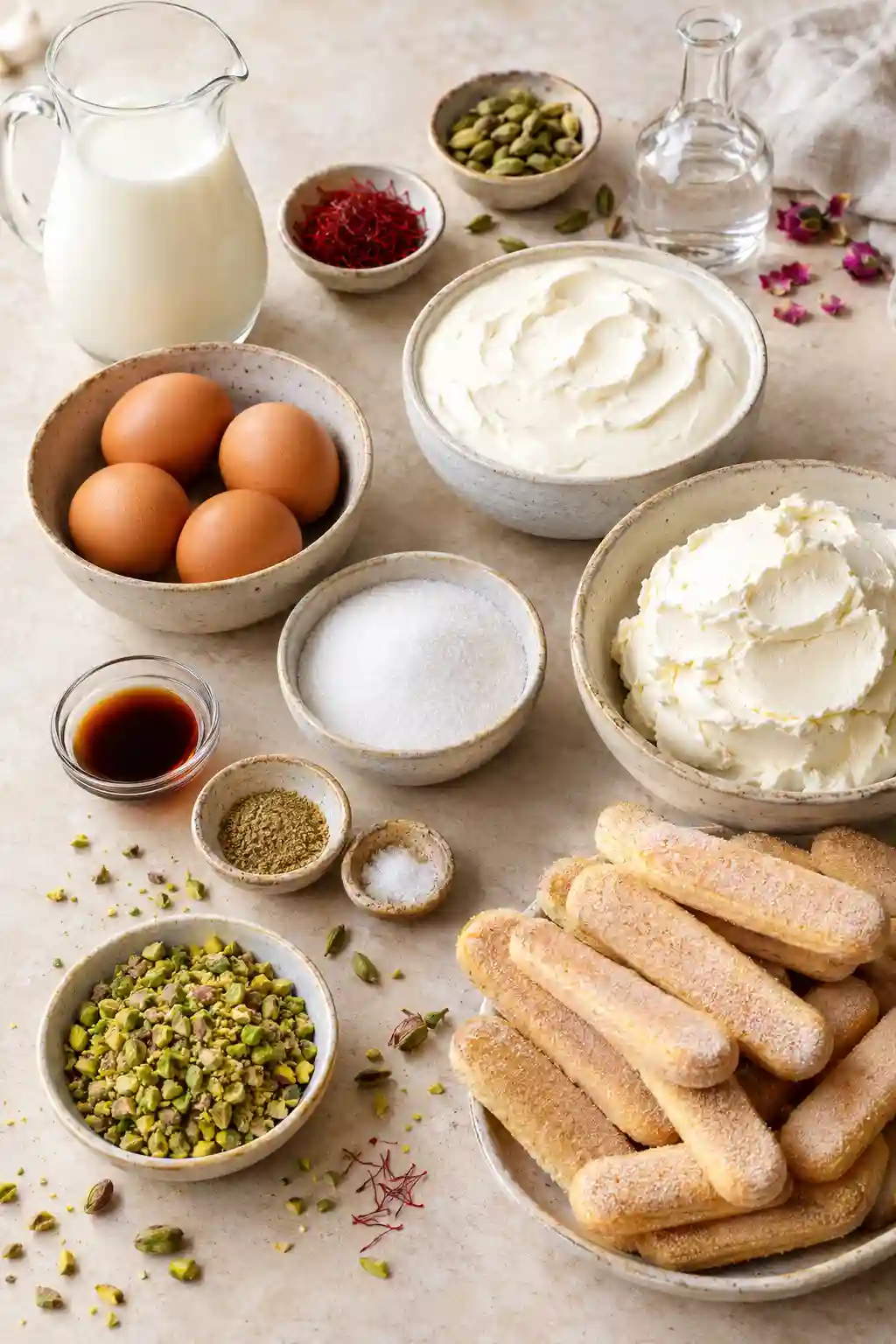
Saffron, Cardamom and Rose Milk
This is where much of the rasmalai-inspired flavor begins. Instead of brewing coffee for the ladyfingers, we’re making an aromatic milk infusion. You’ll need:
- A few strands of saffron
- 1 ice cube for blooming the saffron
- 400 ml whole milk
- 10 cardamom pods
- 1 tablespoon rose water
The saffron is crushed and bloomed with an ice cube before being added to the milk. It might seem like a tiny detail, but it’s worth doing because we want that saffron flavor and color to make their way into the liquid. The cardamom pods are cracked slightly so the seeds are exposed, then warmed with the milk. Rose water goes in after the mixture reaches a simmer.
There’s one thing I’d be careful with here: don’t assume more rose water means more flavor. Rose can go from beautifully floral to surprisingly dominant quite quickly. One tablespoon is enough to complement the saffron and cardamom without making the milk taste perfumed.
Mascarpone Cream
The creamy layer gives Rasmalai Tiramisu its contrast against those fragrant, milk-dipped ladyfingers. For the filling, you’ll need:
- 500 ml double cream or heavy cream
- 4 egg whites
- 50 g granulated sugar for the egg whites
- 4 egg yolks
- 50 g granulated sugar for the egg yolks
- 450 g mascarpone
- 2 teaspoons vanilla extract
- 1 tablespoon cardamom powder
- 1/4 teaspoon salt
You might look at the ingredient list and wonder why sugar appears twice. It’s intentional. One portion is whipped into the egg whites, while the second is whisked with the yolks. The components are prepared separately before being brought together, which helps create a lighter filling rather than something dense and heavy.
The cardamom powder is especially important here. We already have cardamom in the infused milk, but adding it to the cream carries that warm aroma through another layer. A small amount of salt might seem slightly out of place in a dessert like this, yet it helps balance the sweetness and creamy richness.
Ladyfingers and Pistachio Topping
To assemble everything, you’ll need:
- Around 40 to 45 ladyfingers or sponge fingers
- Chopped pistachios for the topping
The exact number of ladyfingers isn’t fixed because their size varies, and so does the dish you might have at home. A dish around 9 x 12 inches works well for this recipe. I’d buy a few more ladyfingers than you think you’ll need rather than discover halfway through the second layer that you’re three biscuits short. I’ve been there with layered desserts, and improvising at that point is rarely fun.
Pistachios are technically optional, but I’d hesitate to leave them out. They add color and a gentle crunch against all those creamy, softened layers. More importantly, they reinforce the flavor profile that makes this feel like an Indian fusion dessert rather than ordinary white tiramisu. Once these three groups of ingredients are ready, making Rasmalai Tiramisu becomes mostly a matter of preparing each component correctly and layering them without over-soaking the ladyfingers.
How to Make Rasmalai Tiramisu
Making Rasmalai Tiramisu becomes much easier when you treat it as three small jobs rather than one complicated dessert. First comes the saffron and cardamom milk, then the mascarpone filling, and finally the layering. I prefer getting the milk ready first because it gives the cardamom time to infuse while I’m working on the cream. And here’s the part that’s easy to underestimate: don’t rush the folding or soaking. Those two little details have a surprisingly big effect on the final texture.
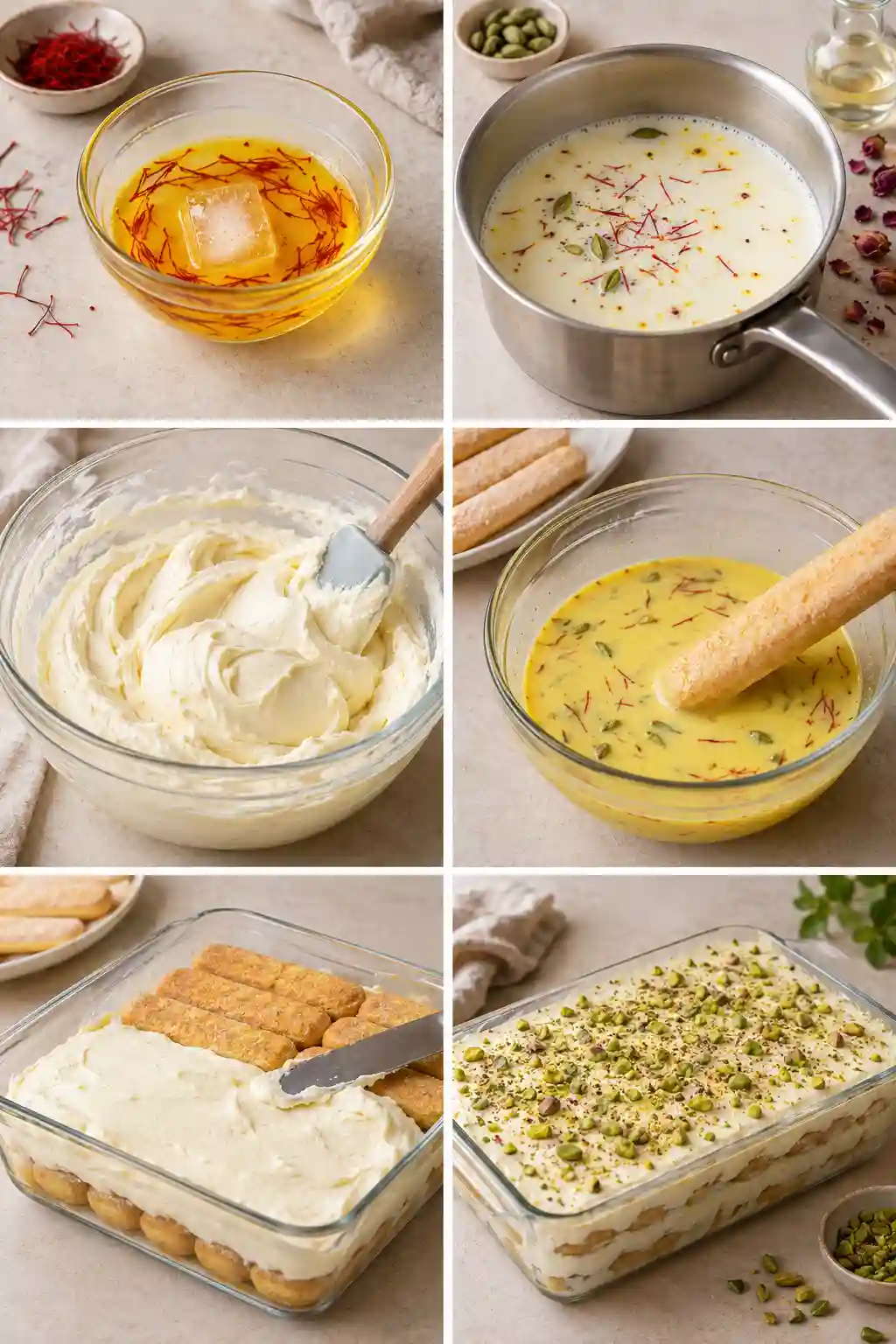
Step 1: Bloom the Saffron
Crush a few saffron strands and place them in a small dish with one ice cube. Leave it alone until the ice has completely melted. The resulting saffron liquid will go directly into the milk.
It feels almost too simple to call this a step, but don’t skip it. The saffron is one of the flavors that gives this Indian tiramisu its distinctive character.
Step 2: Make the Rasmalai-Flavored Milk
Pour the bloomed saffron and its liquid into a saucepan with 400 ml whole milk. Gently crack 10 cardamom pods so the seeds become exposed, then add them to the pan.
Place the saucepan over medium heat and bring the milk to a simmer. As soon as it reaches that point, turn off the heat and stir in 1 tablespoon rose water. Cover the saucepan and set it aside.
Now leave it alone for a while. Seriously. This resting period gives the saffron and cardamom time to perfume the milk while you prepare everything else.
Step 3: Prepare the Mascarpone Filling
Whip 500 ml double cream until firm peaks form, then set it aside. In a separate clean bowl, begin whipping 4 egg whites. Once they’re foamy, gradually sprinkle in 50 g sugar while continuing to whisk. Stop when you have stiff peaks.
Next, bring a little water to a simmer in a saucepan. In another heatproof bowl, whisk 4 egg yolks with the remaining 50 g sugar. Place the bowl over the simmering water without letting its base touch the water. Keep whisking for about 5 minutes, until the mixture becomes paler, increases in volume, and the sugar dissolves.
Remove the bowl from the heat. Add 450 g mascarpone, 2 teaspoons vanilla extract, 1 tablespoon cardamom powder, and 1/4 teaspoon salt. Whisk until smooth.
Add a generous spoonful of whipped cream and whisk it in. Then gently fold in the remaining cream. Fold half of the whipped egg whites into the mixture, followed by the other half. Stop once you can no longer see streaks of egg white. This gentle folding is what helps Rasmalai Tiramisu retain that soft, airy filling instead of becoming unnecessarily dense.
Step 4: Dip the Ladyfingers
Pour the cooled flavored milk into a container that’s easy to dip into. Take one ladyfinger and quickly dip both sides into the milk.
Quickly really does mean quickly here. You’re coating and lightly soaking the biscuit, not leaving it submerged. The ladyfingers will continue absorbing moisture while the dessert rests overnight, so soaking them heavily now can leave you with a mushy base later.
Step 5: Assemble the Rasmalai Tiramisu
Use a dish approximately 9 x 12 inches. Arrange the dipped ladyfingers across the bottom until you have a complete first layer. Spread half of the mascarpone mixture evenly over them.
Dip another batch of ladyfingers in the aromatic milk and arrange them over the cream. Spoon the remaining mascarpone filling on top and smooth the surface gently.
Finish with chopped pistachios. I like adding enough to give the top a little texture and color without completely covering the cream.
Step 6: Refrigerate Overnight
Cover the assembled dessert and place it in the refrigerator overnight. Yes, this is the difficult part because technically the dessert looks finished already. But cutting it now means missing the texture you’re actually trying to create.
During that overnight rest, the ladyfingers soften, the mascarpone layer settles, and the saffron, cardamom, and rose flavors have time to come together. The next day, Rasmalai Tiramisu should be chilled, creamy, and much easier to cut into neat portions. Add a few extra chopped pistachios before serving if you want a fresher-looking finish.
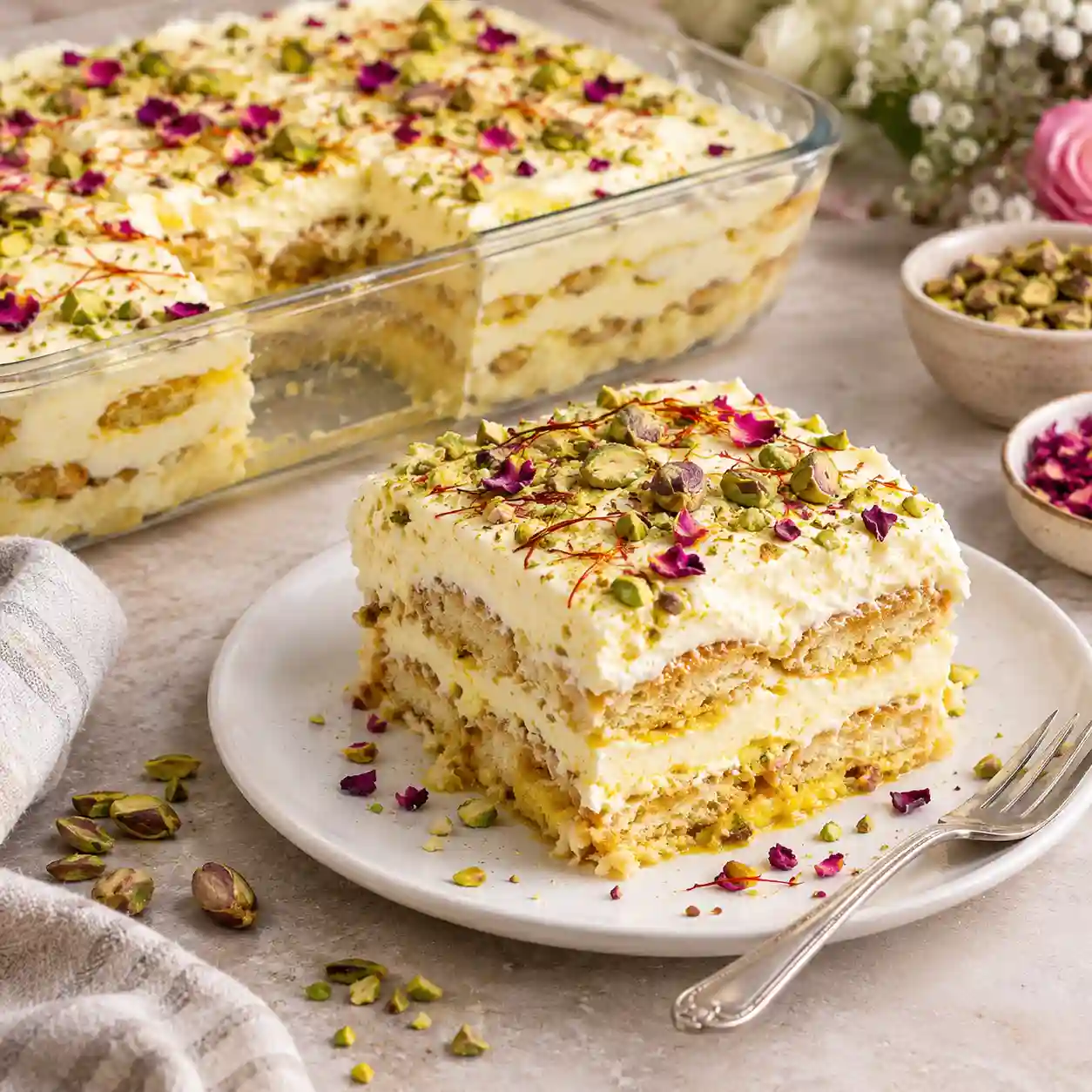

Rasmalai Tiramisu
Ingredients
Method
- Crush the saffron strands and place them in a small dish. Add the ice cube and leave it until completely melted to bloom the saffron.
- Pour the bloomed saffron and its liquid into a saucepan with the whole milk. Lightly crack the cardamom pods to expose the seeds and add them to the milk.
- Heat over medium heat until the milk reaches a simmer. Turn off the heat, stir in the rose water, cover, and set aside to infuse.
- Whip the double cream in a large bowl until firm peaks form. Set aside.
- In a clean bowl, begin whipping the egg whites. Once foamy, gradually add 50 g sugar while continuing to whisk. Whip until stiff peaks form.
- Bring a small amount of water to a simmer in a saucepan. In a separate heatproof bowl, whisk the egg yolks with the remaining 50 g sugar.
- Place the bowl over the simmering water, making sure its base does not touch the water. Whisk for about 5 minutes, until the mixture becomes lighter, increases in volume, and the sugar dissolves.
- Remove from the heat. Add the mascarpone, vanilla extract, cardamom powder, and salt. Whisk until smooth.
- Whisk a large spoonful of whipped cream into the mascarpone mixture. Gently fold in the remaining whipped cream.
- Fold in half of the whipped egg whites, followed by the remaining half. Continue gently until no visible streaks of egg white remain.
- Use a dish approximately 9 x 12 inches. Quickly dip each ladyfinger on both sides in the saffron-cardamom milk. Do not soak them.
- Arrange a complete layer of dipped ladyfingers across the bottom of the dish.
- Spread half of the mascarpone filling evenly over the ladyfingers.
- Add a second layer of quickly dipped ladyfingers.
- Spread the remaining mascarpone mixture over the top and finish with chopped pistachios.
- Cover and refrigerate overnight. Slice and serve chilled the following day.
Notes
| Nutrient | Estimated Amount |
|---|---|
| Calories | 550 kcal |
| Total Fat | 38 g |
| Saturated Fat | 23 g |
| Cholesterol | 155 mg |
| Sodium | 150 mg |
| Total Carbohydrates | 42 g |
| Dietary Fiber | 1 g |
| Total Sugars | 22 g |
| Protein | 9 g |
| Calcium | 140 mg |
| Potassium | 190 mg |
Tips for the Best Rasmalai Tiramisu
A good Rasmalai Tiramisu isn’t particularly difficult to make, but a few small decisions can completely change the result. Most of the trouble happens with texture rather than flavor. Ladyfingers can become too wet, mascarpone cream can lose its lightness, and cutting into the dessert too early can leave you wondering why the layers won’t hold together. I’ve found that this is one of those recipes where being gentle works better than trying to control every step too aggressively.
Don’t Over-Soak the Ladyfingers
This is probably the easiest mistake to make. You have a bowl of beautifully fragrant saffron, cardamom, and rose milk in front of you, so naturally it feels as though the ladyfingers should absorb plenty of it. Actually, resist that instinct.
Dip each ladyfinger quickly on both sides and remove it. That’s enough. The biscuits will continue absorbing moisture as the dessert rests in the refrigerator, and soaking them heavily from the beginning can produce a wet, almost collapsed layer instead of the soft cake-like texture we’re after.
A few things help:
- Let the infused milk cool before dipping.
- Work with one ladyfinger at a time.
- Dip both sides quickly rather than submerging the biscuit.
- Arrange each dipped piece immediately in the dish.
- Don’t pour leftover flavored milk over the assembled layers.
That final point is tempting, especially when you don’t want the aromatic milk to go to waste, but more liquid isn’t necessarily better here.
How to Get a Light and Creamy Mascarpone Filling
The mascarpone layer should feel creamy but still airy. For this Rasmalai Tiramisu, that texture comes from preparing the whipped cream, egg whites, and yolk mixture separately before combining them.
Once the mascarpone has been whisked smoothly into the yolk mixture, start with a generous spoonful of whipped cream. Whisking that first portion in helps loosen the mascarpone base. After that, switch techniques. Fold the remaining whipped cream in gently, then do the same with the whipped egg whites in two additions.
This isn’t the moment for vigorous mixing. The air you’ve worked into the cream and egg whites is part of what keeps the filling light. Fold only until the obvious white streaks disappear.
Temperature matters too. Mascarpone can behave differently when it’s handled too aggressively or when the components are at awkwardly different temperatures. If the filling already looks smooth and combined, stop mixing. Sometimes another thirty seconds with the whisk doesn’t improve anything. It just gives you another thirty seconds to accidentally ruin the texture.
Why Rasmalai Tiramisu Should Chill Overnight
I’ll admit this is the tip I would be most tempted to ignore. Once you’ve finished the layers and scattered pistachios over the top, waiting until tomorrow feels unnecessary. But the overnight rest isn’t simply about making the dessert cold.
While it sits, moisture from the infused milk moves through the ladyfingers and softens their centers. At the same time, the mascarpone filling settles around them, so the separate layers gradually begin to feel like one dessert. The saffron, cardamom, and rose also have more time to mingle instead of tasting like individual additions.
The original recipe specifically recommends leaving the dessert in the refrigerator overnight, and this is one instruction I’d keep exactly as intended.
When you’re finally ready to serve your Rasmalai Tiramisu, take it directly from the refrigerator and slice it while chilled. A clean, sharp knife helps produce more defined portions. And if the first piece isn’t absolutely perfect? That’s normal with creamy layered desserts. The second one usually behaves much better.
Rasmalai Tiramisu Variations and Substitutions
One reason Rasmalai Tiramisu is fun to make is that the basic idea leaves plenty of room for experimentation. Once you have the combination of aromatic milk, soft ladyfingers, and creamy filling, you can adjust individual elements without losing the Indian dessert inspiration. That said, I wouldn’t change everything at once. Saffron, cardamom, and rose already bring quite a lot to the table, and piling on too many additional flavors can make the dessert feel confused rather than creative.
Eggless Rasmalai Tiramisu
The original version uses both egg yolks and whipped egg whites, so it isn’t an eggless recipe. If you’re avoiding eggs, though, you can make a simpler mascarpone filling using mascarpone, whipped heavy cream, sugar, vanilla, and cardamom.
The texture will be slightly different. You lose some of the airy structure provided by the whipped egg whites and the richness contributed by the yolks, but you can still create a smooth, light cream. Whip the heavy cream separately until firm peaks form, loosen the mascarpone with sugar, vanilla, and cardamom, then gently fold the whipped cream into it.
I’d keep the saffron-cardamom milk and ladyfinger layers essentially unchanged. Just check the package if you’re making the dessert for someone who strictly avoids eggs, since some commercially produced ladyfingers contain them.
Mango Rasmalai Tiramisu
Mango is probably the variation I’d try first, especially when ripe, fragrant mangoes are available. The fruit naturally works with cardamom, saffron, pistachios, and creamy dairy, so Mango Rasmalai Tiramisu doesn’t feel like a random extra flavor thrown into the recipe.
You can introduce mango by adding a thin layer of smooth mango puree between the ladyfingers and mascarpone cream. Another option is folding a small quantity of thick mango puree into part of the mascarpone mixture to create contrasting layers.
A few practical points matter here:
- Use thick mango puree rather than watery juice.
- Don’t add so much puree that the mascarpone filling becomes loose.
- Keep the ladyfinger dip quick because mango introduces additional moisture.
- Choose ripe, naturally sweet mangoes when possible.
- Add fresh mango garnish shortly before serving rather than before the overnight rest.
I wouldn’t remove the cardamom entirely when adding mango. That aromatic background is what keeps the variation connected to its rasmalai inspiration.
Rasmalai Tiramisu With Actual Rasmalai
Here’s where the recipe can become considerably richer. The original Rasmalai Tiramisu recreates the flavors associated with rasmalai through saffron, cardamom, rose water, and pistachios rather than placing rasmalai pieces directly between the layers. But if you already have prepared rasmalai, adding pieces can turn the dessert into a more literal fusion.
Drain the rasmalai pieces lightly before using them so they don’t release too much milk into the mascarpone layers. You can cut them into smaller pieces and distribute them over the first cream layer before adding the second row of dipped ladyfingers.
Just keep the quantity restrained. There’s already plenty happening texturally, and too much rasmalai can make each slice heavy and difficult to hold together.
You can also make smaller substitutions without changing the overall identity of the dessert. Almonds can join the pistachio topping, a few dried rose petals can add color, and caster sugar can replace granulated sugar. What I wouldn’t casually replace is the mascarpone. Its mild richness provides the neutral creamy base that allows saffron, rose, and cardamom to remain noticeable instead of competing with a strongly flavored filling.
How to Store Rasmalai Tiramisu
Rasmalai Tiramisu is a dessert that actually benefits from spending time in the refrigerator. Unlike a cake that you might want to serve as soon as it cools, this one needs that resting period for the layers to settle and the ladyfingers to soften. The original recipe specifically calls for refrigerating it overnight before cutting into it, and after seeing what that rest does to the texture, I wouldn’t be tempted to shorten it.
Once assembled, cover the dish before placing it in the refrigerator. A well-covered dessert is less likely to dry out on the surface or pick up aromas from other foods in the fridge. Keep it chilled until you’re ready to serve it, especially since the filling contains mascarpone, cream, and eggs.
How Long Does Rasmalai Tiramisu Last in the Fridge?
For the best experience, I’d prepare Rasmalai Tiramisu the day before you plan to serve it. That gives the saffron, cardamom, and rose-infused milk enough time to soften the ladyfingers while allowing the mascarpone layers to become more stable.
The supplied recipe explains that the flavor and texture are better the following day, but it doesn’t specify a maximum refrigerator storage period. So rather than inventing an exact number of days from the source, the safest editorial recommendation is simple: keep the dessert continuously refrigerated and aim to serve it while the layers still have their intended creamy texture.
There’s also a quality issue to consider. Ladyfingers don’t stop absorbing moisture once they reach the perfect texture. As the dessert continues to sit, they may become softer. That’s why making it ahead is useful, but keeping it around unnecessarily long isn’t really the goal.
Can You Make Rasmalai Tiramisu Ahead of Time?
Yes, and this is one of those rare cases where making dessert ahead isn’t merely convenient. It’s part of the recipe.
Assemble everything the evening before you need it, add the pistachios, cover the dish, and refrigerate it overnight. By the time you’re ready to serve it the next day, the separate layers should have settled into a softer, more cohesive dessert.
If you’re serving it for guests, I’d resist cutting a test slice beforehand. I know, that’s asking for discipline. But keeping the layers intact until serving helps preserve the presentation. When it’s time to portion the dessert, use a clean sharp knife and wipe the blade between cuts if you want more defined edges.
Keep any remaining Rasmalai Tiramisu refrigerated rather than leaving it sitting at room temperature for extended periods. And if you’re adding extra pistachios or decorative rose petals for presentation, you can scatter those over the top shortly before serving. That little final touch keeps the garnish looking fresh while the dessert underneath has already done all the important work overnight.
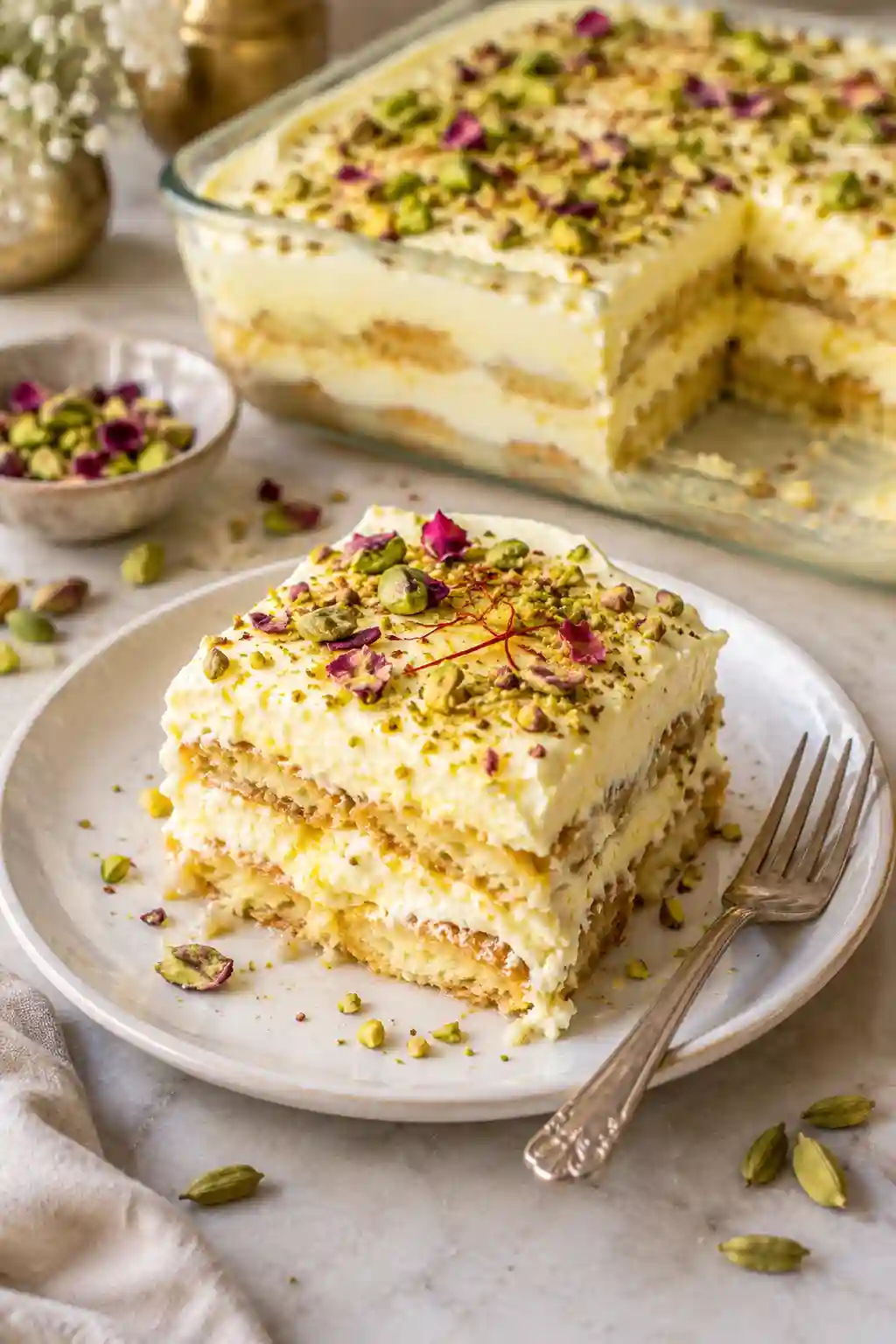
Rasmalai Tiramisu Nutrition Information
Rasmalai Tiramisu is a rich, creamy dessert made with mascarpone, double cream, whole milk, eggs, sugar, ladyfingers, and optional pistachios. So yes, this is firmly in indulgent-dessert territory. And honestly, that’s part of the appeal. The mascarpone and cream create that luxurious texture, while the saffron-infused milk keeps the dessert soft and aromatic rather than simply heavy.
The original recipe doesn’t provide an exact serving yield or nutritional values. Since the size of each slice directly affects calories and macronutrients, it wouldn’t be accurate to attach precise numbers without first deciding how many portions come from the 9 x 12-inch dish.
Rasmalai Tiramisu Nutrition at a Glance
| Nutrient | Amount Per Serving |
| Calories | Depends on serving size |
| Carbohydrates | Not specified |
| Protein | Not specified |
| Total Fat | Not specified |
| Saturated Fat | Not specified |
| Sugar | Not specified |
| Fiber | Not specified |
| Sodium | Not specified |
According to Harvard Health Publishing, nuts such as pistachios provide unsaturated fats, protein, fiber, and other important nutrients.
These values aren’t missing by accident. Rasmalai Tiramisu uses around 40 to 45 ladyfingers, but the exact quantity can vary depending on their size and the dimensions of the serving dish. Pistachios are optional as well. Both details can change the nutritional calculation.
What Contributes Most to the Nutrition?
The mascarpone and double cream provide much of the dessert’s fat and saturated fat, while the granulated sugar and ladyfingers contribute a significant portion of its carbohydrates and sugars. Whole milk and eggs add protein alongside additional fat.
Here’s a simpler way to see where everything comes from:
| Ingredient | Main Nutritional Contribution |
| Mascarpone | Fat, saturated fat, protein |
| Double cream | Fat, saturated fat |
| Whole milk | Protein, carbohydrates, fat |
| Eggs | Protein, fat |
| Granulated sugar | Carbohydrates, sugar |
| Ladyfingers | Carbohydrates, sugar |
| Pistachios | Unsaturated fats, protein, fiber |
The recipe uses 450 g mascarpone, 500 ml double cream, 400 ml whole milk, four whole eggs split into yolks and whites, 100 g total granulated sugar, and approximately 40 to 45 ladyfingers. Those quantities give us the foundation for a proper nutritional calculation, but we still need the final number of servings.
If you decide, for example, that your dish produces a fixed number of equal slices, all ingredient values can be totaled and divided by that serving count. That’s the point where calories, protein, carbohydrates, fat, saturated fat, sugar, fiber, and sodium become meaningful per-serving figures rather than guesses.
For Rasmalai Tiramisu, portion size is especially worth keeping in mind because the mascarpone filling is intentionally rich. Smaller slices can work surprisingly well after a meal, particularly since the saffron, cardamom, rose, and pistachio flavors give each portion plenty of character without requiring an enormous serving.
Make This Rasmalai Tiramisu Recipe
Rasmalai Tiramisu is the kind of fusion dessert that sounds elaborate when you first describe it, yet the idea behind it is surprisingly simple. Instead of relying on the familiar coffee flavors of traditional tiramisu, this version lets saffron, cardamom, rose water, and pistachios take over. Add creamy mascarpone and layers of milk-dipped ladyfingers, and you end up with something that feels familiar and completely different at the same time.
What I like most about this dessert is that none of those flavors needs to fight for attention. The rose stays in the background, saffron gives the milk its distinctive character, cardamom runs through both the infusion and creamy filling, and pistachios add that final bit of texture. Then there are the ladyfingers, which become wonderfully soft after sitting overnight in the refrigerator. That waiting time might test your patience, but it’s also what helps Rasmalai Tiramisu develop the creamy, cohesive texture you’re looking for. The original recipe strongly recommends that overnight rest, and it’s one step worth planning around.
If this is your first time making an Indian tiramisu, don’t worry too much about creating perfectly identical layers. Focus instead on the details that actually affect the result: bloom the saffron, give the flavored milk time to infuse, fold the mascarpone filling gently, and dip rather than soak the ladyfingers. Those small decisions matter far more than whether every pistachio on top lands in exactly the right place.
And once you’ve made the original version, that’s when things get interesting. You can try an eggless filling, introduce mango, add pieces of prepared rasmalai, or keep returning to the saffron, rose, and cardamom combination that started the whole idea. Either way, give your Rasmalai Tiramisu a full night in the fridge, slice it cold the next day, and let that first spoonful decide whether it deserves another appearance at your table.
More Creamy & Fusion Desserts You’ll Love
- Fresh Raspberry Tiramisu – A fruity twist on classic tiramisu with creamy layers and fresh raspberry flavor.
- Mango Sago Pudding Recipe – A creamy Asian-inspired dessert featuring sweet mango and chewy sago pearls.
- Ube Banana Pudding with Coconut Cream – A colorful fusion dessert combining ube, banana, and rich coconut cream.
- Matcha Taho with Brown Sugar Sago – A creative Asian-inspired dessert with matcha and sweet brown sugar sago.
- Viral Japanese Yogurt Cheesecake – A light, creamy dessert that fits naturally into an Asian-inspired sweets collection.
Rasmalai Tiramisu FAQs
1. Does Rasmalai Tiramisu Contain Coffee?
Not this version. Instead of dipping the ladyfingers in strongly brewed coffee, they are dipped briefly in milk infused with saffron, cardamom, and rose water. That’s where much of the rasmalai-inspired flavor comes from. It also gives the dessert a softer, more floral profile than traditional coffee tiramisu.
2. Can I Make Rasmalai Tiramisu Without Eggs?
The original Rasmalai Tiramisu recipe isn’t eggless. It uses four egg whites and four egg yolks in the mascarpone filling. If you want an eggless variation, you can make a simpler filling with mascarpone and whipped heavy cream. Just remember to check your ladyfingers too, since some varieties contain eggs.
3. What Ladyfingers Are Best for Rasmalai Tiramisu?
The source recipe calls for around 40 to 45 sponge fingers, although the exact number depends on their size and the dish you’re using. Choose ladyfingers that can absorb the flavored milk without immediately falling apart. More importantly, dip them quickly on both sides rather than soaking them.
4. How Long Should Rasmalai Tiramisu Chill?
Leave the assembled dessert in the refrigerator overnight. This isn’t simply about serving it cold. The resting time allows the ladyfingers to soften and gives the saffron, cardamom, and rose flavors time to settle into the creamy layers. The original recipe specifically emphasizes not skipping this step because both flavor and texture improve the following day.
5. Why Is My Rasmalai Tiramisu Soggy?
Over-soaking the ladyfingers is one likely reason. They only need a quick dip on each side because they’ll continue absorbing moisture while the dessert rests overnight. The original instructions specifically warn against soaking the sponge fingers. A quick dip gives you a soft layer without turning the biscuits excessively wet.
6. Can I Add Mango to Rasmalai Tiramisu?
Yes, mango can be used as a variation, although it isn’t part of the original recipe provided. A thick mango puree can be added in a thin layer between the ladyfingers and mascarpone cream. Keep the amount controlled so you don’t introduce too much additional moisture into the dessert.
7. Can I Make Rasmalai Tiramisu Ahead of Time?
Yes. In fact, this dessert is designed to be prepared ahead because it needs to rest overnight in the refrigerator. Assemble the layers, finish with chopped pistachios, cover the dish, and refrigerate it until the following day. That makes it particularly convenient when you’re preparing dessert for guests.
8. Do I Need Actual Rasmalai to Make It?
No. This version recreates the characteristic flavor profile using saffron, cardamom, rose water, and pistachios rather than placing rasmalai pieces between the layers. The aromatic milk replaces the traditional coffee dip, while cardamom is also incorporated into the mascarpone filling.