Grab and Go Snack Box Ideas have become one of my favorite solutions for those weeks when I know I’ll be running from one thing to the next. You know the kind of week I’m talking about, right? You leave the house thinking, “I’ll grab something later,” and suddenly it’s mid-afternoon, you’re hungry, and whatever is quickest starts looking pretty tempting.
I’ve had enough of those days to realize that having something already waiting in the fridge makes a surprisingly big difference. Instead of buying another prepackaged snack box, I like putting together my own with foods I actually enjoy. Some days that means salami, cheese, crackers, berries, and almonds. Other days, I want something fresher, so I’ll pack crunchy vegetables with homemade hummus. There really isn’t one correct combination, and honestly, that’s part of what makes these boxes so useful.
If you’re thinking, “That sounds nice, but I don’t want another complicated meal prep project,” I get it. These aren’t meant to become one. The whole idea is to make snacking easier. You can mix and match ingredients you already have, adjust portions to your appetite, and prepare several boxes while you’re already in the kitchen. I usually keep the wet and crunchy ingredients separate when necessary, especially crackers, because nobody gets excited about opening a snack box and finding them soft.
In this guide, I’ll share several easy grab and go snack box ideas, including a charcuterie-style box and a veggie and hummus version, along with simple ways to build your own. We’ll also get into meal prep, storage, ingredient swaps, and the little details that can help everything stay fresh. Once you find a few combinations you genuinely look forward to eating, grabbing a homemade snack box on the way out the door starts feeling less like meal prep and more like doing your future hungry self a favor.
Table of Contents
Table of Contents
Easy Grab and Go Snack Box Ideas
Grab and Go Snack Box Ideas don’t need to involve a long shopping list or an hour of Sunday meal prep. That’s actually what I like most about them. When I open the fridge, I usually start with a simple question: “What do I already have that I’ll actually want to eat tomorrow?” Maybe there’s a little cheese left, some berries that need to be used, a handful of vegetables, or hummus from earlier in the week. Put a few of those things together and, surprisingly, you already have the beginnings of a pretty satisfying snack box.
I also think variety matters more than people sometimes realize. If everything in the container is soft, or everything tastes salty, I get bored halfway through. So I tend to mix something savory with something fresh, then add a little crunch. You might do the same with your own Grab and Go Snack Box Ideas. There’s no rigid formula here, but combining protein, produce, and a crunchy addition tends to make the box feel more complete.
1. Charcuterie Grab and Go Snack Box
This is probably the box I’d choose when I want a snack that feels a little more special without actually requiring much work. Think of it as a small charcuterie board that happens to fit inside a container.
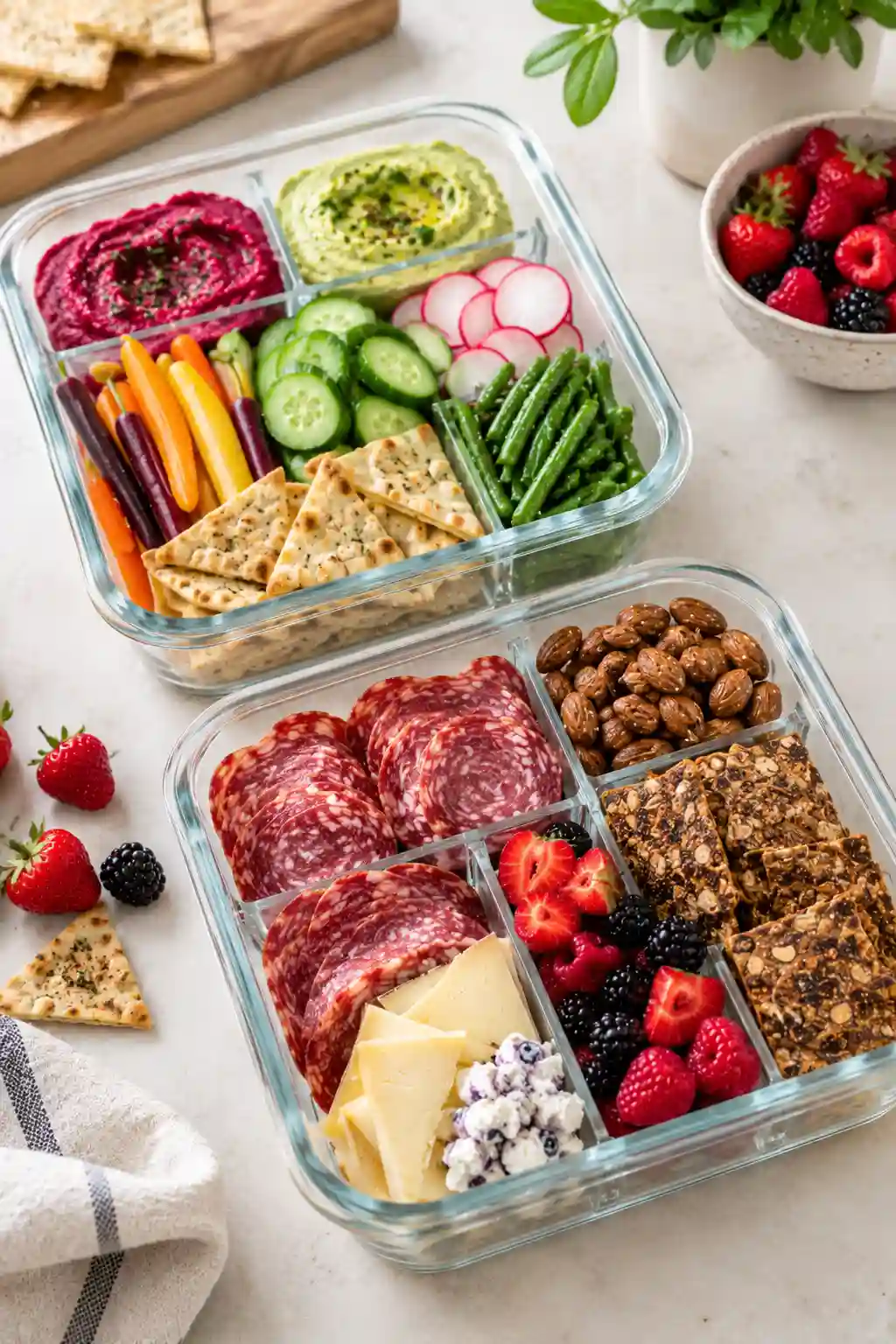
For the original version, the box combines salami, several cheeses, crackers, berries, and roasted almonds. Asiago, manchego, and blueberry chèvre goat cheese bring different flavors and textures, while strawberries, blackberries, and raspberries add something fresh and naturally sweet. The raspberries can even be stuffed with white chocolate chips if you want a small treat alongside the savory ingredients.
A simple combination could include:
- Salami or another sliced meat
- Asiago, manchego, goat cheese, or your favorite cheese
- Flatbread bites or crisp crackers
- Strawberries, raspberries, or blackberries
- Roasted almonds or another favorite nut
And this is where I’d resist making things too complicated. Do you really need three cheeses and several kinds of fruit every time? Probably not. If you have one cheese, one protein, crackers, and some fruit sitting in the fridge, use them. The point is convenience, not recreating a restaurant charcuterie board at your desk.
2. Veggie and Hummus Grab and Go Snack Box
On days when I’m craving something fresher, the veggie and hummus combination makes more sense. The original box uses roasted beet hummus and cilantro Greek hummus alongside rainbow carrots, blanched green beans, radishes, Persian cucumbers, and flatbread bites. It’s basically a portable crudité platter, which sounds slightly fancy for something you can pull straight from the refrigerator.
You can simplify it with whatever vegetables are in season or already sitting in your crisper drawer. And yes, homemade hummus can make the box more interesting, but store-bought hummus is completely reasonable when time is tight. I’d rather prepare a simple box I’ll actually take with me than turn snack prep into another task I keep postponing.
That flexibility is ultimately what makes Grab and Go Snack Box Ideas useful for busy weeks. Start with combinations you already enjoy, change the ingredients when you get bored, and keep the process easy enough that you’ll genuinely want to do it again next week.
3. Protein-Packed Grab and Go Snack Box
Some days, a few crackers and pieces of fruit just aren’t going to cut it. You know those afternoons when lunch feels like it happened hours ago, but dinner is still nowhere in sight? That’s when I’d build the box around foods that make the snack feel more substantial.
Start with one or two protein-rich ingredients, then fill the remaining compartments with foods that add freshness and texture. Cheese and hummus already fit naturally with the combinations we’ve been using, but the basic idea leaves plenty of room for personalization. You could pair your protein with crunchy vegetables, a piece of fruit, nuts, or crackers depending on what you have available.
A simple protein-focused combination might include:
- Cheese
- Hummus
- Roasted almonds
- Carrots or Persian cucumbers
- Berries
- Crackers or flatbread bites
I wouldn’t obsess over squeezing as much protein as possible into every compartment. The goal here is still a snack, not turning a small container into a full meal. I find it more useful to ask, “Will this actually keep me satisfied until I eat again?” If the answer is yes, you’re probably on the right track.
4. Healthy Fruit and Nut Snack Box
There are also days when something lighter and naturally sweet sounds much better than a savory box. Fruit and nuts are probably one of the easiest combinations because there’s almost no preparation involved. Wash the fruit, portion the nuts, pack everything, and you’re basically finished.
The original charcuterie box already gives us a good starting point with strawberries, blackberries, raspberries, and coconut roasted almonds. Instead of treating those ingredients as small additions to cheese and salami, you can make them the center of the box.
Try combining:
- Strawberries
- Raspberries
- Blackberries
- Roasted almonds
- Cheese, if you want something savory
- A few crackers for extra crunch
And, actually, I’d change the fruit depending on the season rather than buying the exact same berries every week. Part of what keeps snack prep from becoming boring is letting the box change naturally. If another fruit is fresher, more affordable, or simply what you’re craving, use that instead.
5. Cheese and Crackers Snack Box
If I had to choose the easiest version of all, this might be it. Cheese and crackers are familiar, quick to portion, and easy to pair with whatever else happens to be in the kitchen. It’s also a useful option for those mornings when you realize you forgot to prep anything the night before.
The original charcuterie combination uses asiago, manchego, and blueberry chèvre goat cheese with flatbread bites and fig and olive crisps. You certainly don’t need that much variety every time. One cheese you really like and one type of cracker can be enough.
From there, I’d add fruit or nuts so the box doesn’t feel like you simply threw cheese and crackers into a container five minutes before leaving. Although, let’s be honest, sometimes that is exactly what happens.
That’s also the beauty of these boxes. They can be carefully meal-prepped for several days or assembled from whatever you find in the refrigerator that morning. Either way, you end up with something portable, customizable, and much more appealing than realizing at 3 p.m. that you forgot to bring a snack.
How to Build a Grab and Go Snack Box
Grab and Go Snack Box Ideas become much easier once you stop thinking in terms of exact recipes. I used to look at a beautifully packed snack box and think, “Okay, but do I really need all of those ingredients?” Not really. What matters more is creating a combination that gives you a little variety and still tastes good after sitting in the refrigerator. I usually think about four things: something filling, something fresh, something crunchy, and, when I feel like it, a dip or a small sweet addition.
The nice part is that this approach works with whatever you already enjoy eating. Your box might contain cheese and fruit one day, hummus and vegetables the next. And if you’re staring into the fridge wondering whether three random ingredients can really count as a snack box, they probably can. There’s no reason to make this more complicated than it needs to be.
Start With a Protein
Protein is usually where I start because it gives the box a little more substance. Salami and cheese work naturally in a charcuterie-style box, while hummus can anchor a vegetable-based option. The original snack boxes use choices such as lamb salami, asiago, manchego, goat cheese, roasted beet hummus, and cilantro Greek hummus.
You don’t need several protein options in every container, though. Choose one or two that pair naturally with everything else. For example, cheese with crackers and berries makes sense without much thought. Hummus, on the other hand, practically asks for crunchy vegetables beside it.
Add Fresh Fruits or Vegetables
This is where Grab and Go Snack Box Ideas can change completely from week to week. Strawberries, raspberries, and blackberries add freshness to a savory charcuterie box, while carrots, radishes, Persian cucumbers, and green beans work well with hummus. Those are the combinations used in the original recipe, but they don’t have to become rules.
I’d actually choose produce based on what looks good, what you already have, and what will hold up well after being packed. That last point matters. A snack can look fantastic when you prepare it, but if it turns watery or limp by the next afternoon, you probably won’t be excited to eat it.
Then comes the crunch. Crackers, flatbread bites, crisp vegetables, or roasted nuts can change how satisfying the whole box feels. I prefer keeping crackers away from moist ingredients whenever the box will sit overnight. It’s a tiny detail, sure, but opening your container to discover soggy crackers is the kind of meal-prep disappointment you only need once.
Finally, add something you genuinely look forward to eating. Maybe that’s a favorite hummus, roasted almonds, an interesting cheese, or a little sweet bite. The original charcuterie box even pairs raspberries with white chocolate chips, which is a good reminder that a homemade snack box doesn’t have to be painfully practical.
Once you get comfortable with this mix-and-match approach, Grab and Go Snack Box Ideas stop feeling like recipes you have to follow. They become more like a framework you can adapt to your appetite, schedule, and whatever happens to be waiting in the refrigerator.
Include Something Crunchy
Here’s the part I used to underestimate: texture. Add crackers, flatbread bites, roasted nuts, or crisp vegetables and suddenly the same snack feels much more interesting. The original charcuterie box uses flatbread bites and fig and olive crisps, while coconut roasted almonds provide another layer of crunch.
There is one small catch. Crackers and moisture are not friends. If you’re preparing several boxes ahead of time, keep crackers separated from hummus, juicy fruit, or freshly washed vegetables. You can also add them in the morning before leaving, which is the approach recommended in the original recipe for meal-prepped boxes.
Finish With a Dip or Something Sweet
This is the part that makes the box feel like yours. Maybe you want homemade hummus with vegetables. Maybe you’d rather add roasted almonds, a favorite cheese, or a small sweet bite. The original charcuterie box even stuffs raspberries with white chocolate chips, and I like that idea because it keeps the snack from feeling overly calculated.
Once you understand this basic framework, Grab and Go Snack Box Ideas become less about following someone else’s ingredient list and more about using what works for your routine. Start with protein, add fresh produce and crunch, then finish with something you’ll look forward to eating. After a few boxes, you probably won’t even think about the formula anymore. You’ll open the fridge, spot a few ingredients, and know exactly what belongs together.
Best Ingredients for Grab and Go Snack Box Ideas
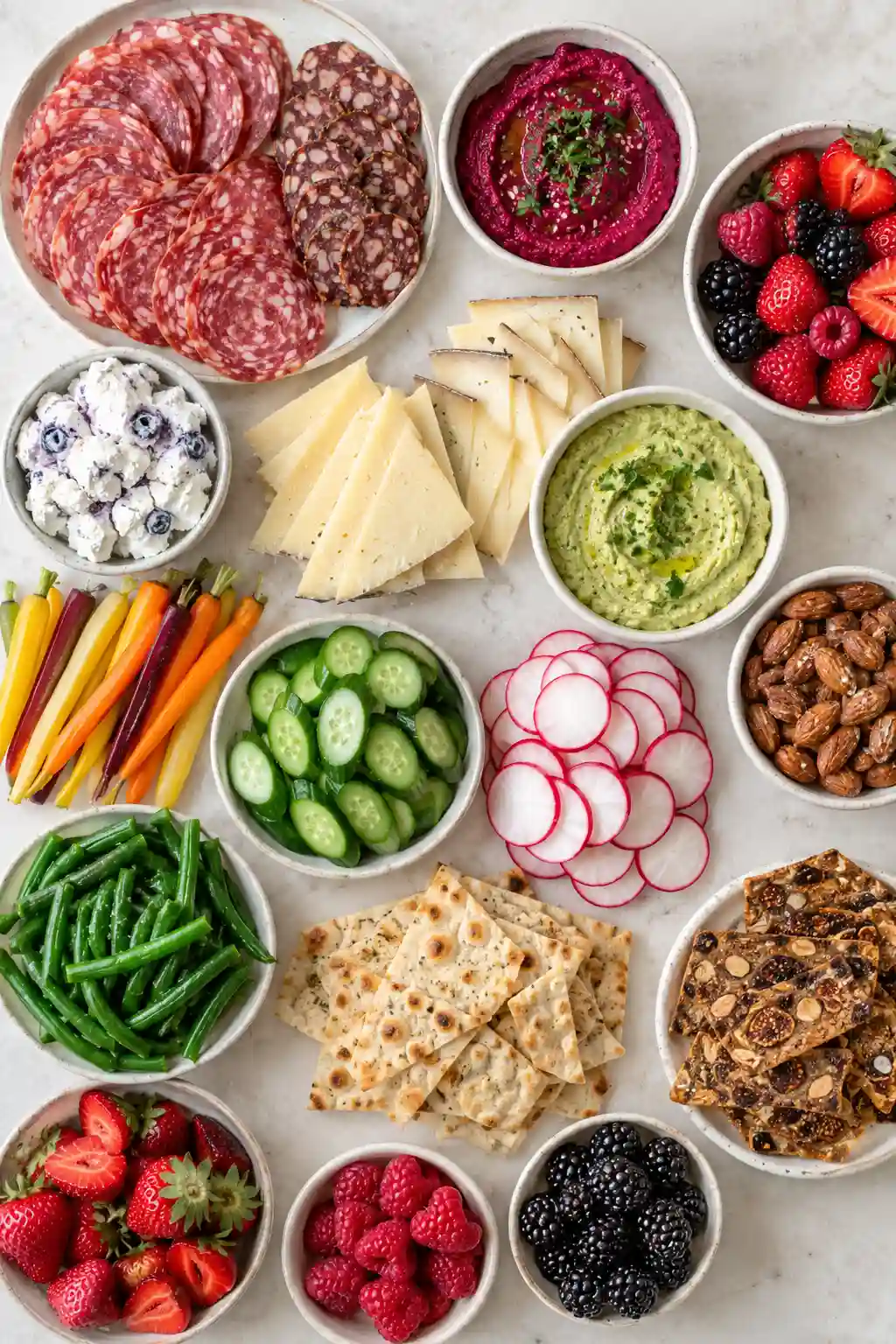
Choosing ingredients for Grab and Go Snack Box Ideas sounds simple until you’re standing in front of an open refrigerator trying to decide what actually goes together. I’ve done that more times than I’d like to admit. My first instinct used to be to add a little bit of everything, but that usually created a crowded box rather than a better snack. These days, I’d rather choose a few ingredients that complement each other and, just as importantly, hold up well once they’ve been packed.
The original boxes are a good example of how different food groups can work together. One leans into the savory charcuterie side with salami, cheeses, crackers, berries, and almonds. The other combines fresh vegetables with two types of homemade hummus. You can use those combinations as a starting point, then adjust them according to your appetite, schedule, and whatever is already in your kitchen.
Protein Options
For me, protein is one of the easiest places to begin because it helps determine the direction of the entire box. Salami and cheese naturally lead toward a charcuterie-style snack, while hummus works especially well when you want to pack more vegetables.
The original charcuterie box uses lamb salami along with asiago, manchego, and blueberry chèvre goat cheese. You don’t need that many options, though. One protein you enjoy can be enough, particularly if you’re adding nuts or another filling ingredient elsewhere in the container.
Fresh Fruits and Vegetables
Fresh produce adds color, texture, and a welcome contrast to richer ingredients. Strawberries, raspberries, and blackberries appear in the original charcuterie box, while rainbow carrots, radishes, Persian cucumbers, and blanched green beans are paired with hummus in the veggie version.
This is also where I think Grab and Go Snack Box Ideas should stay flexible. If strawberries aren’t great this week, don’t buy them just because they’re on an ingredient list. Use fruit you actually want to eat. The same goes for vegetables. Seasonal produce can keep your boxes from tasting identical week after week.
Crackers, Nuts, and Crunchy Additions
A little crunch changes the experience more than you might expect. Flatbread bites and fig and olive crisps are used alongside the cheeses and salami in the original box, while coconut roasted almonds add another crunchy option.
The trick is deciding when to pack these ingredients. Crackers can absorb moisture from fruit, vegetables, or dips, so I prefer to keep them in a separate compartment. If that isn’t possible, adding them shortly before leaving home can help preserve their texture.
Dips and Spreads
Hummus is especially useful because it can turn a handful of raw vegetables into something you genuinely look forward to eating. The source recipe includes both roasted beet hummus and cilantro Greek hummus, giving the veggie box two noticeably different flavors.
Homemade is great when you have time, but I wouldn’t let that become a requirement. Some weeks I’m happy to make a dip from scratch. Other weeks? Not happening. A favorite store-bought hummus can make just as much sense when convenience is the reason you’re preparing these boxes in the first place.
Something Sweet
A snack box doesn’t have to finish with dessert, but a small sweet element can make it more enjoyable. Fresh berries may already provide enough sweetness. The original version takes things a little further by stuffing raspberries with white chocolate chips. It’s a tiny addition, but that’s exactly the point.
The best ingredients for Grab and Go Snack Box Ideas aren’t necessarily the fanciest ones or even the ones that look best in a perfectly arranged container. They’re foods you enjoy, that travel well, and that you’ll still be happy to see when hunger hits later in the day. Once those three things line up, choosing what goes into the next box becomes much easier.
How to Meal Prep Grab and Go Snack Boxes
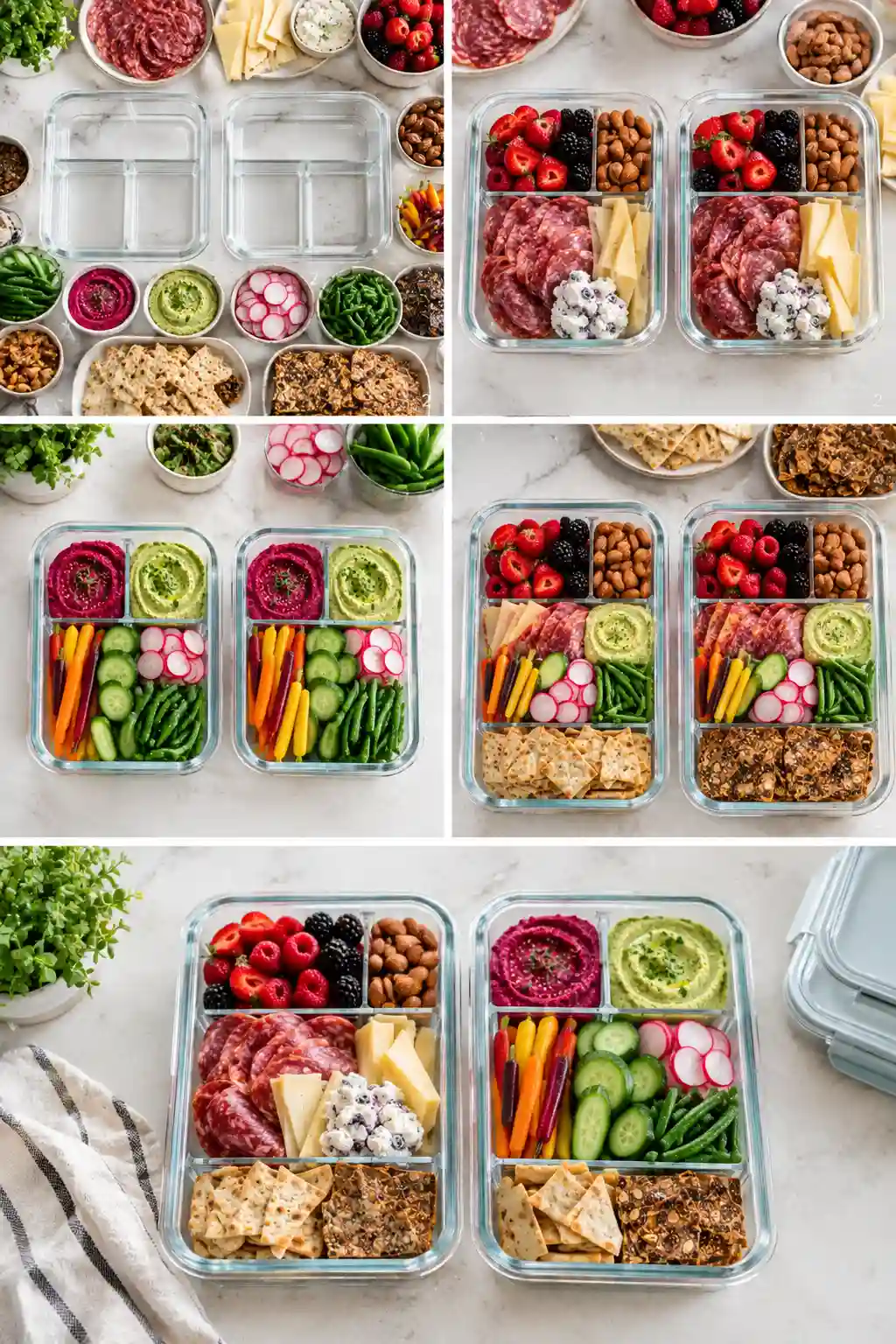
Meal prepping Grab and Go Snack Box Ideas is one of those habits that sounds like extra work until you realize how much time it can save later. I used to think, “Do I really need to prep snacks too?” Meals already felt like enough. But when the afternoon came around and there was nothing ready to grab, I usually ended up eating whatever was easiest. Preparing a few snack boxes while you’re already in the kitchen can solve that problem without turning Sunday into an endless meal-prep session.
The original recipe recommends preparing these boxes ahead and storing them in the refrigerator, which makes them especially practical for busy weeks. I’d keep the process simple. Wash and cut the produce, portion your protein and dips, and divide everything between your containers. You don’t have to prepare five identical boxes either. Changing the fruit, cheese, vegetables, or dip slightly can make each day feel less repetitive.
How Far in Advance Can You Prepare Snack Boxes?
The original recipe recommends consuming the prepared snack boxes within 3 to 4 days. That gives you a useful meal-prep window without requiring you to prepare an entire week at once.
I prefer thinking in batches of a few days for another reason: texture. A box that tastes fresh on day two may not be quite as appealing several days later, particularly when cut produce is involved. Preparing smaller batches also lets you change combinations during the week instead of committing to exactly the same snack every afternoon.
When assembling Grab and Go Snack Box Ideas ahead of time, consider which ingredients actually benefit from early preparation. Carrots, radishes, green beans, cheese, salami, and hummus are fairly straightforward to portion in advance. More delicate ingredients may be better added closer to the day you plan to eat them.
How to Keep Crackers From Getting Soggy
This seems like a tiny meal-prep detail until it happens to you. You open your carefully prepared box, reach for a cracker, and it bends instead of crunching. Not exactly the snack you pictured.
The original article specifically recommends adding crackers in the morning before heading out rather than storing them inside the prepared box for several days. That’s a simple solution, especially when your container doesn’t completely separate wet and dry foods.
If your snack container has individual compartments, keep crackers away from hummus, washed vegetables, juicy berries, and other moisture-rich ingredients. Nuts can also provide crunch when you want something that is easier to portion ahead.
How to Store Your Prepared Snack Boxes
Once assembled, the original snack boxes are stored in the refrigerator and are intended to be eaten within 3 to 4 days. A divided container is particularly useful because it prevents ingredients from mixing together before you’re ready to eat.
I’d also avoid packing vegetables while they’re still dripping from washing. Drying them first takes another minute, but it helps keep excess moisture out of the container. Hummus should stay in its own compartment or a small sealed container, while crackers can wait until the morning if necessary.
That’s really the advantage of meal prepping Grab and Go Snack Box Ideas. You do a little of the decision-making ahead of time, then your future self gets to open the refrigerator and find something already prepared. And on a genuinely hectic day, that small bit of preparation can feel surprisingly useful.
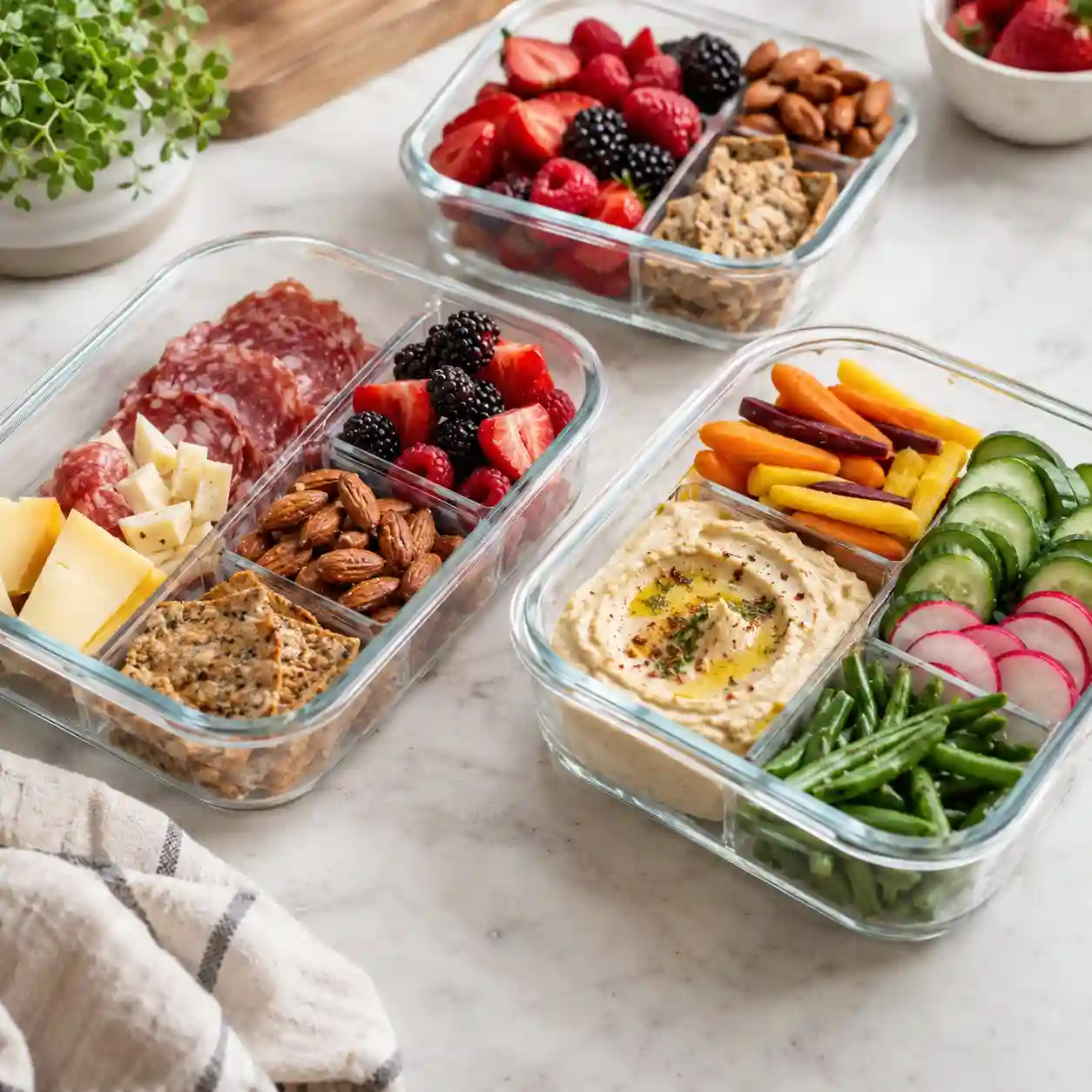

Grab and Go Snack Box Ideas
Ingredients
Method
- Prepare four divided snack containers: two for the charcuterie snack boxes and two for the veggie and hummus snack boxes.
- For the charcuterie boxes, divide the salami, lamb salami, Asiago cheese, Manchego cheese, and blueberry chèvre evenly between two containers.
- Divide the raspberries, strawberries, blackberries, and coconut roasted almonds between the two charcuterie boxes. Add the white chocolate chips, if using.
- For the veggie and hummus boxes, divide the roasted beet hummus and cilantro Greek hummus between two containers.
- Add the rainbow carrots, blanched green beans, sliced radishes, and Persian cucumbers, dividing them evenly between the two veggie boxes.
- Divide the flatbread bites and fig and olive crisps between the appropriate snack boxes. For meal prep, keep the crackers separate and add them shortly before serving to help them stay crisp.
- Cover the snack boxes and store them in the refrigerator until ready to serve.
- Enjoy within 3 to 4 days for the best freshness.
Notes
| Nutrition | Charcuterie Snack Box | Veggie & Hummus Snack Box |
|---|---|---|
| Calories | ~600 kcal | ~220 kcal |
| Protein | ~27 g | ~7 g |
| Carbohydrates | ~39 g | ~32 g |
| Total Fat | ~39 g | ~9 g |
| Saturated Fat | ~15 g | ~1.5 g |
| Fiber | ~7 g | ~8 g |
| Sugar | ~15 g | ~8 g |
| Sodium | ~1,200 mg | ~400 mg |
Homemade Hummus for Your Grab and Go Snack Box Ideas
Homemade hummus can completely change Grab and Go Snack Box Ideas, especially when vegetables are doing most of the heavy lifting. Carrots and cucumbers on their own? Fine. Give me a creamy, flavorful hummus to dip them into and suddenly I’m much more interested. The original snack box uses two homemade versions, cilantro Greek hummus and roasted beet hummus, alongside rainbow carrots, green beans, radishes, Persian cucumbers, and flatbread bites.
I know what you might be thinking: “If these boxes are supposed to save time, why am I making hummus from scratch?” Fair question. I wouldn’t make it every single time either. But hummus is something you can prepare ahead, and once there’s a container waiting in the refrigerator, assembling the actual snack boxes becomes much quicker. The original recipe makes this same point, while also suggesting store-bought hummus when you don’t want to make your own.
Cilantro Greek Hummus
The cilantro Greek hummus starts with familiar hummus ingredients, including chickpeas, tahini, lemon, olive oil, garlic, cumin, salt, and pepper. What makes this version more distinctive is the addition of lime and fresh cilantro. After everything is processed until smooth, the hummus is topped with chopped Persian cucumber, red onion, cherry tomatoes, Kalamata olives, feta cheese, and more cilantro.
That topping is what catches my attention. It adds texture and turns a basic dip into something that feels much more complete. You can serve it with vegetables, pita, flatbread, or crackers, so it fits naturally into different Grab and Go Snack Box Ideas without requiring you to repeat exactly the same combination each time.
To prepare it, drain and rinse the chickpeas, then process them with the cumin, salt, pepper, tahini, lemon juice, lime juice, cilantro, olive oil, and minced garlic until the texture becomes smooth. Transfer the hummus to a bowl and finish it with the cucumber, onion, tomatoes, olives, feta, and cilantro topping.
Roasted Beet Hummus
If the cilantro version is fresh and herby, roasted beet hummus goes in a different direction. The original recipe combines chickpeas with tahini, lemon juice and zest, olive oil, cumin, salt, pepper, roasted garlic, and a small roasted beet. A little reserved chickpea liquid or water helps everything blend into a creamy consistency.
The beet needs a little preparation first. It’s peeled, chopped into cubes, and roasted with garlic at 400°F for about 30 minutes according to the source recipe. After draining the chickpeas and reserving some of their liquid, everything goes into the food processor and is blended until creamy. The finished hummus can then be topped with additional olive oil and hemp seeds.
Would I make both hummus flavors every week? Probably not. Actually, one generous batch is more realistic for most busy weeks. You could make cilantro Greek hummus one week, roasted beet hummus the next, and use a favorite store-bought version when life gets particularly hectic.
That flexibility is exactly why hummus works so well with Grab and Go Snack Box Ideas. One dip can be paired with different vegetables, crackers, and other additions throughout the week, giving you variety without forcing you to prepare an entirely new snack every day.
Grab and Go Snack Box Ideas for Adults, Work, and Travel
Grab and Go Snack Box Ideas become much more useful when you build them around where you’re going and who will actually eat them. A snack box I’d pack for an afternoon at work probably wouldn’t look exactly like one I’d bring on a road trip. And a box for kids? That can be another story entirely. The basic idea stays simple, though: combine foods you enjoy, create some contrast between fresh and crunchy ingredients, and make the portions practical for the occasion.
That flexibility is what keeps snack boxes from becoming another repetitive meal-prep habit. You can make them more filling, lighter, travel-friendly, or even party-ready without completely changing the way you prepare them.
High-Protein Snack Box Ideas for Adults
Snack box ideas for adults often need to be a little more substantial, especially when the box has to carry you through a long afternoon. I like starting with one or two protein-containing foods, then adding produce and something crunchy rather than filling every compartment with the same type of ingredient.
Cheese, hummus, almonds, and salami are all used in the original combinations and give you several directions to work with. You might pair cheese and salami with berries and crackers, for example, or go with hummus, crunchy vegetables, almonds, and flatbread bites.
Healthy Snack Box Ideas for Adults
Healthy snack box ideas for adults don’t have to mean carrots in one compartment and celery in another. I’d get bored with that pretty quickly. A more enjoyable approach is to combine fresh produce with foods that bring different flavors and textures.
The veggie box in the original recipe does this nicely with roasted beet hummus, cilantro Greek hummus, rainbow carrots, green beans, radishes, Persian cucumbers, and flatbread bites. Fruit, nuts, or cheese can also be added depending on your preferences and how substantial you want the snack to feel.
Grab & Go Snack Box Ideas for Work
Grab & go snack box ideas for work need to survive more than the trip from the refrigerator to the kitchen table. They should be easy to carry, simple to eat, and organized well enough that hummus doesn’t somehow end up coating everything else before lunch.
A divided container helps keep the components separate. For work, I’d choose ingredients that require very little fuss once you’re ready to eat: sliced cheese, berries, vegetables, hummus, nuts, salami, or crackers all fit the format.
If you’re meal prepping several boxes, keep moisture in mind. The original recipe recommends adding crackers in the morning before heading out so they remain crisp rather than sitting alongside moist ingredients for several days.
Road Trip Snack Ideas for Adults
Road Trip Snack Ideas deserve a slightly different approach because convenience becomes even more important when you’re eating in a car. Nobody wants to discover halfway down the highway that the snack they packed requires a plate, three napkins, and more coordination than expected.
For simple car trip snacks, choose foods that can be portioned before leaving and eaten without much preparation. Nuts, crackers, firm fruit, vegetables, and other easy-to-handle foods can form the base of your road trip snack setup. Refrigerated foods such as cheese or hummus require appropriate cold storage while traveling.
These same combinations can double as practical Road Trip Food Ideas when you want several smaller options rather than relying on one snack. And if you’ve been searching for Car Trip Food Ideas because everyone gets hungry at different times, individual containers make portioning much easier.
This is also where Grab and Go Snack Box Ideas really earn their name. Pack them before leaving, organize foods so they’re easy to reach, and you remove one more decision from the journey.
Trip Snacks for Kids
Trip Snacks For Kids work best when there’s a balance between familiarity and variety. I wouldn’t use a road trip as the moment to suddenly introduce five foods a child has never wanted to try before. Start with ingredients they already enjoy, then add one or two different colors or textures around those favorites.
Fruit, cheese, crackers, cucumbers, and other familiar options can be portioned into separate compartments. What works will depend heavily on the child, of course. One might head straight for berries while another ignores everything except the crackers.
For travel, I’d also keep the setup uncomplicated. Smaller portions and foods that are easy to pick up can make the box easier to manage in the car.
Camping Snack Box Ideas
Camping Snack Box Ideas need a little more planning because storage conditions matter. For anything requiring refrigeration, proper cold storage is essential. If that isn’t practical for your particular trip, choose suitable shelf-stable foods instead of assuming your usual refrigerator snack box will work outdoors.
Nuts and certain crackers are convenient starting points because they’re portable and don’t require preparation immediately before eating. Depending on your storage setup, you can then build around them with other appropriate foods.
Actually, this is one situation where I’d plan the container before the ingredients. A box that works perfectly for the office may be annoying inside an overpacked cooler.
Snack Box Ideas for a Party
Snack box ideas for a party take the same concept and make it more social. Instead of preparing one large board that everyone reaches into, individual snack boxes can give guests their own mix of savory, fresh, and crunchy foods.
The charcuterie combination from the original recipe is particularly easy to adapt because it already includes salami, multiple cheeses, crackers, berries, and roasted almonds. You can simplify that combination or change the ingredients according to your guests.
For parties, presentation matters a little more than it does when I’m packing something for myself at 7 a.m., but I still wouldn’t overcomplicate it. A few colorful ingredients arranged neatly can do plenty.
Whether you’re considering snack box ideas for travel, work, adults, kids, camping, or entertaining, the basic principle stays surprisingly consistent. The best Grab and Go Snack Box Ideas are the ones adapted to the situation. Start with foods people genuinely want to eat, think about how the box will be stored and transported, and let the occasion determine everything else.
Tips for Making the Best Grab and Go Snack Boxes
The best Grab and Go Snack Box Ideas aren’t necessarily the ones with the most ingredients. After putting a few boxes together, you start noticing that the little details matter more. Maybe the crackers went soft because they were packed beside freshly washed vegetables. Maybe you added too much food and ended up bringing half of it home. Or maybe everything was technically nutritious, but nothing in the box made you particularly excited to open it. I’ve found that a little planning helps, but overthinking every compartment defeats the whole purpose.
The goal is convenience. Your snack box should make a busy day easier, not create another complicated meal-prep routine. A few simple habits can help ingredients stay fresh, make the combinations more enjoyable, and reduce the amount of food that ends up forgotten in the refrigerator.
Choose Foods That Travel Well
Before adding something to a snack box, I like to ask one practical question: “Will I still want to eat this a few hours from now?” Some foods simply travel better than others.
The original combinations rely heavily on portable ingredients such as cheese, salami, berries, almonds, carrots, radishes, Persian cucumbers, green beans, hummus, and crackers. That’s a useful starting point because these ingredients can be divided easily into individual portions.
If you’re taking the box away from home, think about how long it will be out of the refrigerator and keep foods that require refrigeration properly chilled.
Mix Different Textures and Flavors
This sounds like a small thing, but it can be the difference between a snack you enjoy and one you eat because it happens to be there.
I like having at least two contrasting textures. Creamy hummus works with crisp vegetables. Soft cheese becomes more interesting with crunchy crackers. Sweet berries can balance salty salami or cheese. Roasted almonds add another layer of crunch.
The original charcuterie box does this particularly well by combining cheeses, salami, crackers, berries, and coconut roasted almonds rather than relying on a single type of food.
When you’re experimenting with Grab and Go Snack Box Ideas, don’t be afraid of combinations that seem a little unexpected. Sweet and savory foods can work surprisingly well together, and sometimes the ingredient you add almost as an afterthought becomes the part you look forward to most.
Keep Wet and Dry Ingredients Separate
If there’s one snack-box lesson worth remembering, it’s this one. Moisture has a habit of finding whatever ingredient you most wanted to stay crunchy.
Keep hummus in its own compartment and dry washed vegetables before packing them. Crackers deserve even more attention. The original recipe recommends adding crackers in the morning before leaving when the boxes have been prepared in advance.
If your container has reliable dividers, you may be able to pack everything together. Otherwise, a small separate container or bag for crackers can save you from that disappointing first soggy bite.
Pack Portions That Match Your Appetite
It’s tempting to fill every empty compartment simply because the space is there. I used to do this too, and then I’d wonder why leftovers kept coming home.
Think about when you’ll eat the box. A mid-morning snack probably doesn’t need the same amount of food as something intended to carry you through a long afternoon. Adjust the amount of cheese, hummus, nuts, crackers, fruit, and vegetables accordingly.
Portioning this way also makes it easier to distinguish between a snack box and a small meal. Neither approach is wrong. You just want the amount of food to make sense for the moment you plan to eat it.
Use Ingredients You Actually Enjoy
This might be the most important tip, even though it sounds almost too obvious. Don’t fill a box with ingredients you think you should eat while ignoring the foods you genuinely enjoy.
The original recipe repeatedly encourages swapping ingredients according to personal preference, whether that means choosing different charcuterie items, seasonal vegetables, or store-bought hummus instead of making it from scratch. That flexibility is worth keeping.
Ultimately, successful Grab and Go Snack Box Ideas should fit into your routine almost without you noticing. Keep the combinations simple, separate ingredients when necessary, rotate foods before boredom sets in, and pay attention to what actually comes back uneaten. After a few rounds of meal prep, your own habits will probably tell you more about the perfect snack box than any rigid ingredient list ever could.
Nutrition Information for Grab and Go Snack Box Ideas
The nutrition information for Grab and Go Snack Box Ideas will vary quite a bit depending on what you put in each container and, just as importantly, how much you use. A charcuterie-style box with salami, several cheeses, crackers, fruit, and nuts will have a different nutritional profile from a veggie box built around hummus, carrots, cucumbers, radishes, and green beans.
That variability isn’t necessarily a downside. It actually gives you room to build a snack around what you need that day. Want something more substantial? You might include cheese, hummus, nuts, or salami. Looking for something lighter and fresher? Vegetables, berries, and hummus can take up more of the box.
Here’s a simple look at how some of the ingredients used throughout these Grab and Go Snack Box Ideas contribute to the overall snack:
| Ingredient | Nutritional Contribution | Found In |
| Salami | Protein and fat | Charcuterie snack box |
| Cheese | Protein, fat, and calcium | Charcuterie snack box |
| Chickpea hummus | Plant protein, carbohydrates, and fiber | Veggie and hummus box |
| Almonds | Plant protein, fats, and fiber | Charcuterie snack box |
| Berries | Carbohydrates, fiber, and vitamin C | Charcuterie snack box |
| Carrots | Carbohydrates, fiber, and beta-carotene | Veggie and hummus box |
| Persian cucumbers | Water, fiber, and micronutrients | Veggie and hummus box |
| Green beans | Fiber, carbohydrates, and micronutrients | Veggie and hummus box |
| Crackers | Primarily carbohydrates, depending on the variety | Both snack box styles |
| Tahini | Fats, plant protein, and minerals | Homemade hummus |
| Olive oil | Primarily unsaturated fat | Homemade hummus |
For a balanced snack box, I like to include a mix of whole grains, fruits or vegetables, and protein-rich foods, an approach that aligns with Harvard’s guidance on building a healthy, balanced plate.
The source recipe doesn’t provide calories or macronutrient totals for a complete snack box, so I wouldn’t attach one fixed number to these combinations. Portions can change dramatically, especially with calorie-dense ingredients such as cheese, nuts, salami, tahini, and olive oil.
If you want more control over the balance of your box, think about the ingredients as building blocks rather than chasing a perfect number. Pair a protein-containing food with fruit or vegetables, add something crunchy, and adjust the portion based on whether you’re preparing a light snack or something more substantial.
That’s another reason I like Grab and Go Snack Box Ideas: the same basic concept can be adjusted to different appetites without completely changing how you prep it. A few thoughtful ingredient swaps can make the box lighter, more filling, more plant-focused, or simply better suited to what you feel like eating that day.
Final Thoughts on Grab and Go Snack Box Ideas
Grab and Go Snack Box Ideas are really about making busy days a little easier. After trying different combinations, that’s the part I keep coming back to. It isn’t about creating the prettiest container or filling every compartment perfectly. It’s about opening the refrigerator when you’re rushing out the door and realizing, “Oh, good, I already have something ready.” On certain mornings, that small win feels bigger than it probably should.
Start with foods you genuinely enjoy, then build around them. Salami, cheese, hummus, vegetables, berries, nuts, and crackers can all work, but there’s no reason your box has to look exactly like someone else’s. The original recipe itself encourages mixing and matching ingredients according to personal preference, which is probably the most useful rule to keep.
And your combinations will likely change over time. Mine would. Some weeks a veggie and hummus box sounds perfect; other weeks I’d reach for cheese, crackers, berries, and something salty without thinking twice. Grab and Go Snack Box Ideas are flexible enough to follow those changing cravings instead of forcing you into the same meal-prep routine every week.
So start simple. Prepare a few boxes, notice what you finish first and what keeps coming home untouched, then adjust the next batch. That little bit of trial and error is probably more useful than following a perfect formula. Eventually, your favorite Grab and Go Snack Box Ideas will become the ones you barely have to think about, because you already know exactly what you’ll be happy to find waiting in the fridge.
More Easy Snack Recipes You’ll Love
- Banana Sushi Fun Healthy Snack Kids – A fun, easy banana snack that works perfectly for lunchboxes and grab-and-go eating.
- Protein Popsicles – A refreshing protein-packed snack that’s simple to prep ahead.
- Monk Fruit Peanut Butter Cups – A homemade peanut butter treat that’s convenient for snack time.
- Banana Berry Protein Smoothie – A quick fruity option for busy mornings or an afternoon snack.
- Cottage Cheese Recipes – High-protein ideas that can inspire simple, filling snack combinations.
Grab and Go Snack Box Ideas FAQs
When you start preparing Grab and Go Snack Box Ideas regularly, a few practical questions tend to come up. What belongs in the box? How early can you prepare it? And, perhaps most importantly after one unfortunate meal-prep experience, how do you stop the crackers from turning soft? The good news is that snack boxes are meant to be flexible, so most of these questions have fairly simple answers.
1. What do you put in a grab and go snack box?
A good snack box can combine a protein or filling ingredient, fresh fruit or vegetables, something crunchy, and an optional dip or sweet addition. For example, the original charcuterie box combines salami, cheese, crackers, berries, and roasted almonds, while the veggie version pairs two types of hummus with carrots, green beans, radishes, Persian cucumbers, and flatbread bites.
You don’t need every category in every box. If cheese, crackers, berries, and nuts are enough for your afternoon, stop there. If you know you’ll be hungry, add hummus, vegetables, or another ingredient you enjoy.
2. Are snack boxes good for meal prep?
Yes. Grab and Go Snack Box Ideas can work particularly well for meal prep because many of the ingredients can be portioned ahead of time and kept refrigerated. The source article specifically presents these boxes as a prep-ahead option for busy weeks.
I wouldn’t necessarily prepare an entire week at once, though. A smaller batch gives you more flexibility and helps preserve the texture of fresh ingredients.
3. How long do homemade snack boxes last?
The original recipe recommends storing prepared snack boxes in the refrigerator and consuming them within 3 to 4 days.
The exact quality of individual ingredients can vary, so pay attention to what you’re packing. Fresh produce should be washed and dried before going into the container, and refrigerated ingredients should remain properly chilled.
4. How do you keep crackers fresh in a snack box?
Keep crackers separated from moist foods such as hummus, washed vegetables, and juicy fruit. If you’re preparing the boxes several days ahead, another easy solution is to leave the crackers out entirely and add them shortly before you leave.
That’s actually what the original recipe recommends: prepare the boxes ahead, then add the crackers in the morning before heading out the door. It requires almost no extra effort and can make a noticeable difference in texture.
5. What are good high-protein foods for a snack box?
Cheese, hummus, nuts, and salami are some of the protein-containing options already represented in the original boxes. You can choose one or combine a couple depending on how filling you want the snack to be.
I’d avoid turning the protein question into a numbers game unless you have a specific nutritional target. For an everyday snack box, it’s often more useful to think about satisfaction. Will this combination comfortably get you through to your next meal? That’s usually the question that matters when you’re actually standing in the kitchen packing it.
Ultimately, the flexibility of Grab and Go Snack Box Ideas is what makes them so practical. You can adjust the portions, ingredients, textures, and flavors without having to relearn the whole process. Once you know what keeps well and which combinations you actually enjoy, preparing the next batch becomes almost automatic.