Whole roasted cauliflower recipe… sounds simple, right? Almost too simple.
That’s exactly what I thought the first time I tried it.
I remember looking at a plain head of cauliflower on my counter and thinking, There’s no way this turns into something impressive. Maybe you’ve had that same doubt. Maybe you’re here because you want something healthy, something different, but you’re not fully convinced this is it.
And honestly… fair.
Because if you’ve ever had badly made oven roasted cauliflower, you know how disappointing it can be. Soft in the wrong way. Flavor sitting only on the surface. No real depth. Just… there.
But here’s where things shift.
The first time I got it right, I didn’t even realize what I had done differently at first. The kitchen started smelling like garlic butter slowly caramelizing, the edges began turning that deep golden color, and when I finally cut into it, it had that perfect contrast, slightly crisp outside, tender inside.
That moment changed how I saw cauliflower completely.
And if I’m being honest, it stopped being just a side dish. It became something I could actually center a meal around. A proper cauliflower main dish, not just an afterthought.
So if you’re wondering whether this is just another easy cauliflower recipe or something genuinely worth making… you’re about to find out.
Because this guide is built to help you get it right the first time. No guesswork. No bland results. Just a baked whole cauliflower that actually delivers on flavor, texture, and that quiet little “wow” moment when you bring it to the table.
Table of Contents
Table of Contents
Ingredients for the Best Whole Roasted Cauliflower Recipe
Essential ingredients for a flavorful whole roasted cauliflower
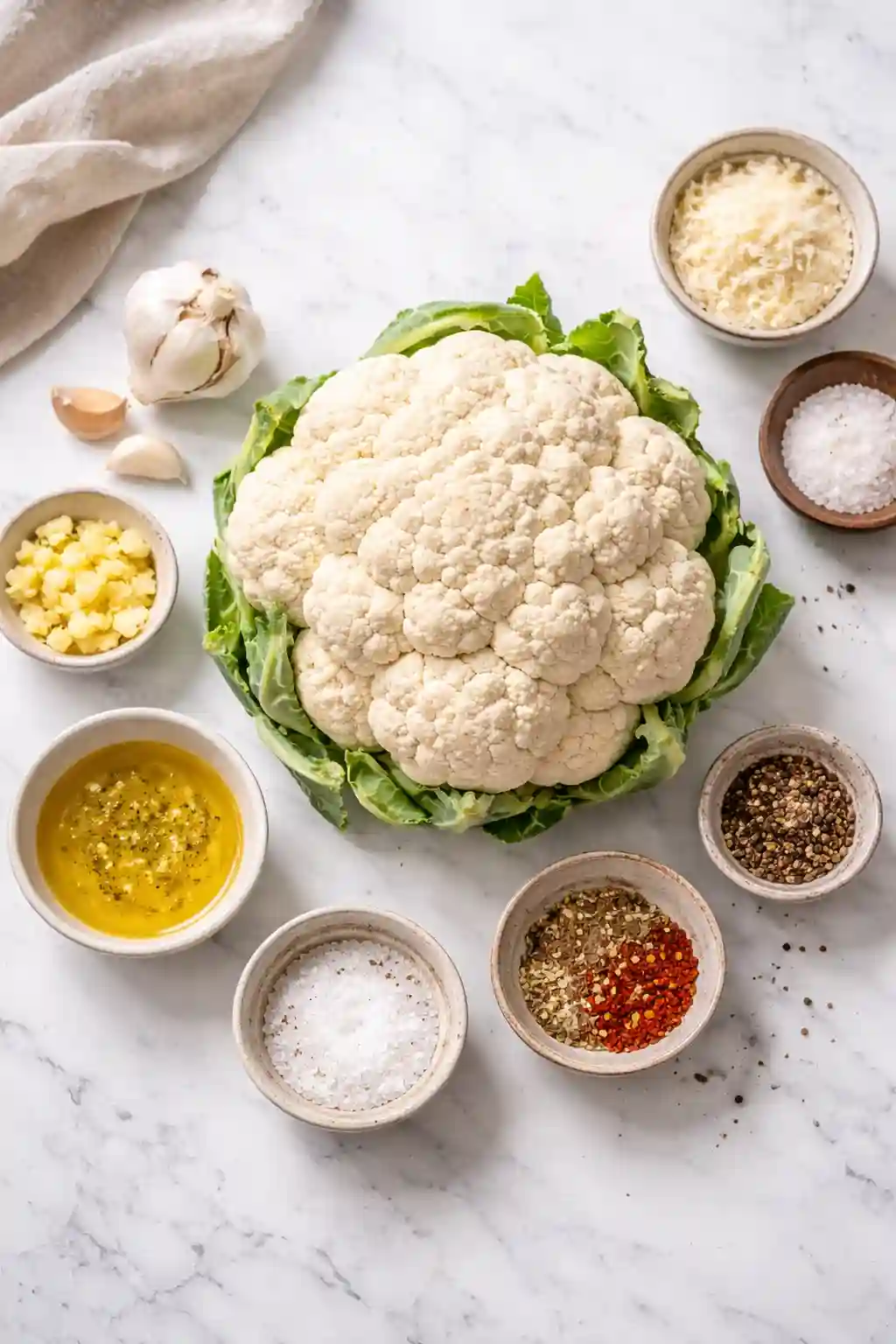
At first glance, this whole roasted cauliflower recipe looks almost too minimal. And that’s part of the charm… but also where things can quietly go wrong.
You’re working with just a few ingredients:
- one whole head of cauliflower
- butter or olive oil
- garlic
- parmesan cheese or a vegan alternative
- salt and black pepper
That’s it.
But here’s the thing most recipes don’t really say out loud. When the ingredient list is this short, every single element has to pull its weight. There’s nowhere to hide.
I learned that the hard way. First time I made it, I used just a little oil and a bit of garlic. Thought it would be enough. It wasn’t. The outside had flavor, sure, but inside… kind of bland.
Now I go a bit heavier on the coating. Not excessive, just enough to make sure the flavor actually gets into the cauliflower, not just sits on top of it.
And if you’re aiming for that golden roasted finish with slightly crispy edges and tender inside, fat matters more than you think. Butter gives richness. Olive oil keeps it lighter. Both work, just depends on the mood you’re going for.
Optional add-ons to elevate flavor and depth
This is where things start to get interesting.
You can keep it simple, and honestly, it will still be good. But if you want something that feels a bit more like a complete cauliflower dinner recipe, a few additions make a big difference:
- smoked paprika for warmth
- cumin or curry powder for depth
- chili flakes for a subtle kick
- fresh herbs for brightness
- tahini for a more Middle Eastern style finish
Sometimes I stick with garlic and parmesan. Other times I go full spice mode. It really depends on what I’m craving… or what I have left in the fridge.
And if you’re going for a vegan whole roasted cauliflower recipe, just swap butter for olive oil and skip the cheese. Add a tahini drizzle at the end and it honestly doesn’t feel like you’re missing anything.
Chef’s shortcut for maximum flavor without extra effort
This is one of those small tricks that changes everything.
Instead of adding ingredients separately, mix everything into one warm mixture before applying it. Melted butter or warmed oil helps carry the garlic and spices deeper into the cauliflower.
Then comes the part most people rush.
Don’t just pour it on top.
Take a moment to push some of that mixture underneath the florets. Not perfectly, not obsessively, just enough to get inside. That’s where the real flavor builds.
If you skip that step, you’ll still get a decent baked cauliflower. But if you do it, the difference is noticeable. Like, first bite noticeable.
And yeah, it takes an extra minute or two. But it’s probably the highest return-on-effort step in this entire recipe.
How to Make Whole Roasted Cauliflower (Step-by-Step)
Step-by-step method for a perfect whole roasted cauliflower recipe
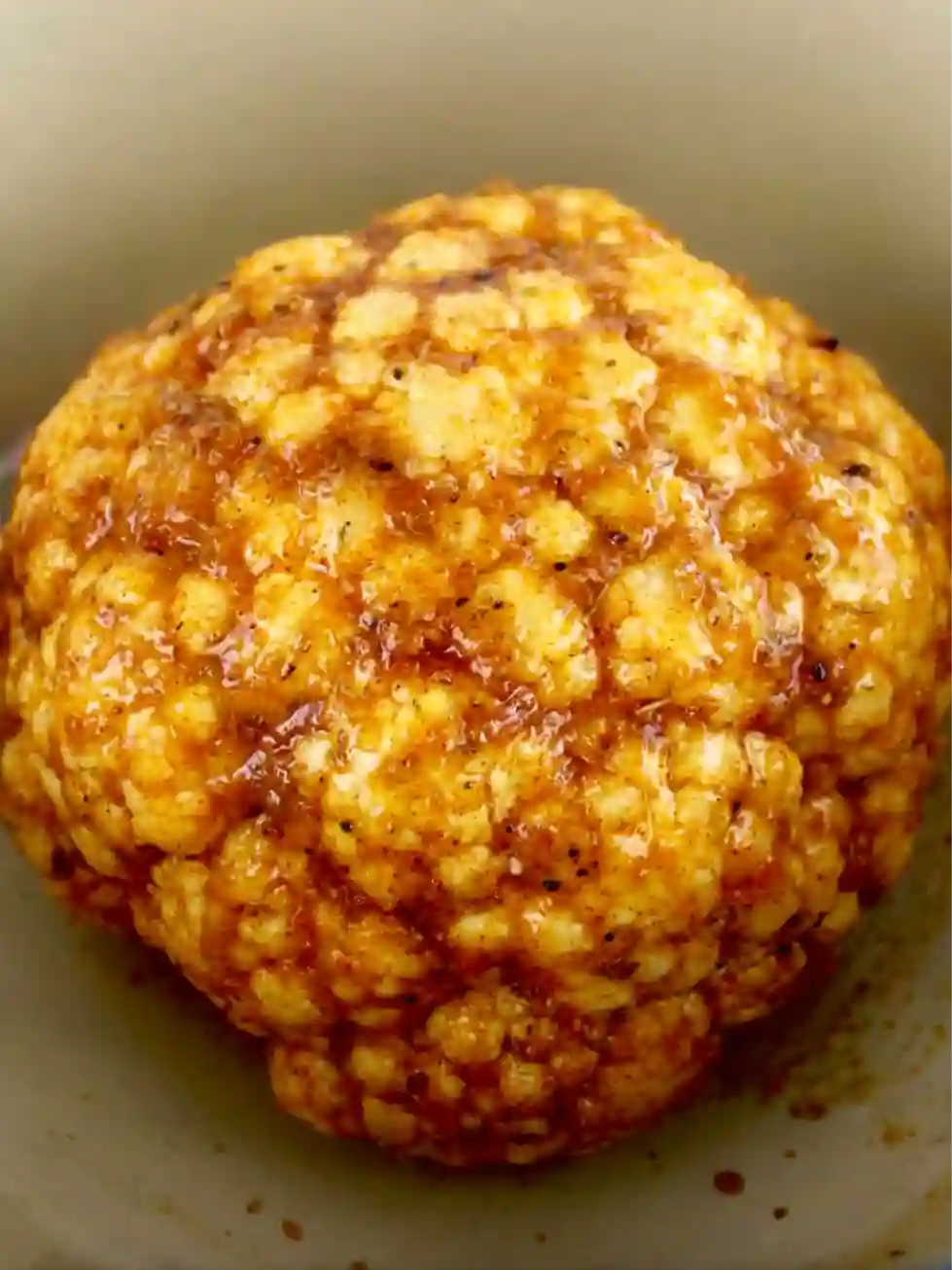
Making a whole roasted cauliflower recipe is not complicated… but the way you do each step changes everything.
Start by preheating your oven to 375°F. While that’s heating up, wash your cauliflower and trim the leaves. Try not to cut too much of the stem because it holds everything together. I made that mistake once and the whole thing kind of fell apart halfway through cooking.
Place the cauliflower head in a baking dish or Dutch oven, stem side up.
Now, in a separate bowl, mix your butter or oil, garlic, seasoning, and cheese if you’re using it. This mixture is basically the heart of your whole roasted cauliflower recipe, so don’t rush it.
Pour about half of it underneath the cauliflower. Not just around it, actually under it. Let it seep into those little gaps.
Then flip the cauliflower over and coat the top and sides with the rest.
It might feel a bit messy. That’s normal.

Where most people go wrong (and how to fix it)
If I’m being honest, this is where most whole roasted cauliflower recipe attempts fail.
People pour everything on top and call it a day.
I did that too the first time. The top looked great, golden and flavorful. But inside? Kind of plain. Almost like two different dishes in one.
The fix is simple. You need to get that mixture inside the cauliflower, not just on it.
Also, don’t skip covering it during the first part of cooking. That trapped heat creates steam, which helps cook the inside properly. Without it, you risk burning the outside before the center becomes tender.
Another thing… don’t keep opening the oven. I know it’s tempting to check, but every time you do, you slow down the cooking process.
Pro tip: how to season deep inside the cauliflower
This is probably the one step that turns a decent whole roasted cauliflower recipe into something memorable.
After adding the mixture underneath, use a spoon or brush to gently push it between the florets. You don’t need to be perfect here. Just aim to get some flavor into the inner layers.
Think of it like marinating, but in a shortcut version.
If you skip this, you’ll still get a good roasted cauliflower. But if you take that extra minute, the flavor becomes more balanced. Every bite tastes seasoned, not just the outer layer.
And once you’ve done it this way, it’s hard to go back.


Whole Roasted Cauliflower Recipe
Ingredients
Method
- Preheat oven to 375°F
- Wash and trim the cauliflower, keeping the core intact
- Place the cauliflower in a baking dish, stem side up
- In a bowl, mix butter or oil, garlic, seasoning, salt, and pepper
- Pour half of the mixture underneath the cauliflower
- Flip and coat the top and sides evenly
- Cover and bake for 30 minutes
- Remove cover and increase heat to 425°F
- Roast for another 15 minutes until golden and tender
- Let cool slightly, slice, and serve
Notes
| Nutrient | Amount |
| Calories | 240 kcal |
| Total Fat | 23 g |
| Saturated Fat | 8 g |
| Carbohydrates | 7 g |
| Fiber | 4 g |
| Net Carbs | 3 g |
| Sugar | 3 g |
| Protein | 4 g |
- For crispy edges, uncover earlier and increase heat slightly
- For a vegan version, use olive oil and skip cheese
- For deeper flavor, add spices or tahini after roasting
How Long to Roast a Whole Cauliflower (Perfect Timing Guide)
Exact roasting time based on size
Timing can feel a bit confusing when you first try a whole roasted cauliflower recipe. I remember googling three different sources and getting three different answers… not helpful.
So here’s the simple version.
For a medium-sized cauliflower, your whole roasted cauliflower recipe will usually need about 45 minutes total:
- 30 minutes covered at 375°F
- 15 minutes uncovered at 425°F
If your cauliflower is smaller, it might be ready closer to 35–40 minutes. Larger ones can push past 50 minutes.
The key is not just time, though. It’s texture.
You’re looking for that moment when a knife slides in with slight resistance going in, but comes out clean. That’s when your whole roasted cauliflower recipe is perfectly cooked. Not mushy, not underdone.
Covered vs uncovered cooking time
This part changes everything, and it’s often overlooked in a whole roasted cauliflower recipe.
The covered phase is what cooks the inside. It traps steam and softens the core. Without it, you’ll end up with a cauliflower that looks done outside but still feels firm inside.
Then comes the uncovered phase. This is where the magic happens.
The heat increases, the moisture evaporates, and the outside starts to turn golden roasted with those slightly crispy edges. That contrast is what makes a whole roasted cauliflower recipe actually satisfying.
If you skip uncovering, you’ll miss that texture completely.
If you uncover too early, it might dry out.
There’s a balance here… and once you get it right, you’ll feel it more than measure it.
Should you blanch cauliflower before roasting?
This is one of those questions where the answer is both yes and no, which is a bit frustrating, I know.
Technically, you don’t need to blanch anything for a whole roasted cauliflower recipe. The oven does the job just fine.
But… if you’re short on time or working with a really dense cauliflower, blanching for a few minutes can speed things up.
That said, there’s a trade-off.
Blanching adds moisture. And moisture is the enemy of crispiness.
So if your goal is that golden roasted exterior with crispy edges and tender inside, it’s usually better to skip it.
Unless you’re in a rush. Then it can help.
Kind of one of those “depends on what you want more” situations.
How to Get Crispy Edges and Tender Inside Every Time
The secret to crispy edges without drying it out
This is where a whole roasted cauliflower recipe either becomes incredible… or just “fine.”
Because let’s be honest, nobody is chasing soft cauliflower with no texture. What you really want is that contrast. Slightly crispy edges on the outside, tender inside, and a deep golden roasted finish.
The trick is not just high heat. It’s when you use it.
In a proper whole roasted cauliflower recipe, you don’t start hot. You build up to it. The first phase cooks the inside gently. The second phase is where you push the heat and let the outside develop that crust.
I used to crank the oven up from the beginning thinking it would make things crispier. It didn’t. It just made the outside cook too fast while the inside lagged behind.
Once I switched to finishing with higher heat, everything changed. The edges started to caramelize properly, and that’s when the texture finally felt right.
Moisture control: the hidden factor most people ignore
If your whole roasted cauliflower recipe keeps turning out soft or slightly mushy, this is probably why.
Water.
Cauliflower holds more moisture than you think, especially after washing it. If you don’t dry it properly, that moisture turns into steam in the oven, and steam kills crispiness.
So take a minute. Pat it dry. Even let it sit out for a bit if you have time.
Also, avoid adding extra liquid to the dish. It might seem like a good idea, but it actually works against you. In a well-balanced whole roasted cauliflower recipe, the natural steam from covering it is already enough.
Too much moisture equals soft texture. Less moisture gives you that golden roasted finish.
If you want crispy vs tender: what to adjust
This is where you get to control the outcome of your whole roasted cauliflower recipe depending on what you prefer.
If you want more crispy edges:
- uncover the cauliflower a bit earlier
- increase the final oven temperature slightly
- use a bit more oil or butter
If you want it softer and more tender:
- keep it covered longer
- avoid pushing the heat too high at the end
- use slightly less fat
There’s no single “perfect” version. It depends on what you enjoy.
Some days I want that almost melt-in-your-mouth texture. Other days, I’m chasing those crispy edges that crack slightly when you cut into them.
And honestly, once you understand this balance, your whole roasted cauliflower recipe stops being a fixed recipe… and starts becoming something you can adjust without thinking too much about it.
Flavor Variations: Garlic, Vegan, Indian & Middle Eastern Styles
Garlic roasted cauliflower (the classic everyone comes back to)

If there’s one version of a whole roasted cauliflower recipe that almost never fails, it’s garlic.
Simple, familiar, and honestly… hard to beat.
You mix garlic with melted butter or olive oil, maybe add parmesan, and as the cauliflower roasts, something happens. The smell alone kind of takes over the kitchen. That slow, rich garlic aroma mixed with that golden roasted finish… it’s the kind of thing that makes people wander in and ask what you’re cooking.
I’ve tried a lot of variations, but I keep coming back to this one. It just works.
And if you’re trying a whole roasted cauliflower recipe for the first time, this is probably the safest place to start. It gives you that crispy edges, tender inside balance without overcomplicating things.
Vegan whole roasted cauliflower options that still feel rich
Now, you might think removing butter and cheese makes this less interesting. I thought that too at first.
But a good vegan whole roasted cauliflower recipe can actually feel just as satisfying, sometimes even more balanced.
Swap butter for olive oil, and instead of cheese, finish it with something like:
- tahini sauce
- lemon juice
- a touch of garlic and cumin
What you get is lighter, but still full of flavor. Not heavy, not greasy, just clean and surprisingly rich in a different way.
And if I’m being honest, there are days where I actually prefer this version. Especially when I want something that fits into a more plant based meal without feeling like I’m sacrificing taste.
Spiced versions: Indian and Middle Eastern inspiration
This is where a whole roasted cauliflower recipe starts to feel less like a basic dish and more like something you’d order at a restaurant.
Add spices like:
- garam masala
- turmeric
- cumin
- coriander
Or go in a Middle Eastern direction with:
- harissa
- paprika
- tahini drizzle
Suddenly, the flavor profile changes completely.
I tried a spiced version once thinking it might be too much. It wasn’t. It actually made the cauliflower feel more like a proper cauliflower main dish instead of just a side.
And here’s the interesting part… once you start experimenting with spices, you realize how flexible a whole roasted cauliflower recipe really is. Same base, totally different experience depending on what you add.
Kind of makes you look at that simple head of cauliflower differently.
Common Mistakes That Ruin Roasted Cauliflower
Why your whole roasted cauliflower recipe turns mushy
This is probably the most frustrating outcome when making a whole roasted cauliflower recipe.
You follow the steps, the timing seems right… and yet, when you cut into it, it’s soft in the wrong way. Not tender. Just mushy.
Most of the time, it comes down to moisture.
If the cauliflower isn’t dried properly after washing, all that trapped water turns into steam during cooking. And steam, while useful at the beginning, becomes your enemy if there’s too much of it.
Another issue is overcooking. It’s easy to leave it in “just a bit longer” thinking it will get better. It usually doesn’t. A whole roasted cauliflower recipe needs balance. Too little time and it’s firm. Too much and it collapses.
If you’ve ever had that happen, yeah… you’re not alone.
Why it tastes bland even when you added seasoning
This one is a bit sneaky.
You add garlic, spices, salt… everything seems right. But somehow, the flavor doesn’t come through the way you expected in your whole roasted cauliflower recipe.
Here’s why.
Most of the seasoning stays on the surface.
So when you slice into it, the inside tastes plain compared to the outside. It’s almost like two different layers instead of one cohesive dish.
The fix is simple but often skipped. You need to get seasoning inside the cauliflower, not just on top. Even a small effort here makes a huge difference in how your whole roasted cauliflower recipe tastes overall.
Also, don’t underestimate salt. Not too much, but enough to actually bring out the flavor.
Quick fixes that instantly improve your results
If your whole roasted cauliflower recipe hasn’t been turning out the way you want, a few small adjustments can change everything:
- Dry the cauliflower thoroughly before cooking
- Season both the inside and outside
- Start covered, finish uncovered
- Use enough fat to help with caramelization
- Avoid overcooking past the tender stage
None of these are complicated. That’s the funny part.
But together, they’re what separate an average result from something that actually feels satisfying.
And once you dial these in, your whole roasted cauliflower recipe becomes a lot more consistent… and a lot harder to mess up.
Can Whole Roasted Cauliflower Be a Main Dish?
Turning cauliflower into a true centerpiece meal
At some point, this question comes up naturally.
Can this actually be a full meal… or is it just a side trying to look fancy?
I used to think it couldn’t carry a plate on its own. It felt like something you’d serve next to meat, not instead of it. But after making a whole roasted cauliflower recipe the right way, that perspective shifted a bit.
When it comes out of the oven golden, slightly crisp on the outside, tender inside, and full of flavor, it doesn’t feel like a side anymore. It feels intentional.
And presentation plays a role here too.
Serve it whole, bring it to the table, slice it in front of people… there’s something about that moment. It creates a pause. People notice. It’s simple, but it works.
What to serve with roasted cauliflower
Now, even if you treat it as a main dish, pairing still matters.
If you want something more filling, you can build around it:
- a light salad with lemon dressing
- a creamy sauce like tahini or yogurt-based
- grains like quinoa or rice if you’re not strictly low carb
Or, if you’re keeping it lighter and closer to a plant based dish, just add a good sauce and maybe some roasted chickpeas on the side.
Sometimes I keep it minimal. Other times I build a full plate around it. Depends on the mood… or honestly, how hungry I am.
When it works better than meat (yes, really)
This might sound a bit surprising.
But there are moments where a whole roasted cauliflower recipe actually feels like a better option than meat.
Not always. But sometimes.
When you want something lighter but still satisfying. When you don’t feel like dealing with heavy proteins. Or when you just want a change without sacrificing that “main dish” feeling.
It’s not trying to replace meat. It just… stands on its own.
And once you experience that, you stop seeing it as a backup option. It becomes something you choose on purpose.
Storage, Reheating and Meal Prep Tips
How to store roasted cauliflower properly
Once your cauliflower comes out of the oven, it’s tempting to leave it out and come back to it later. I’ve done that more times than I’d like to admit.
But if you want to keep the flavor and texture as close as possible to when it was fresh, storage matters.
Let it cool first. Not completely cold, just not steaming anymore. Then place it in an airtight container and store it in the fridge. It will stay good for about 3 to 4 days.
A whole roasted cauliflower recipe tends to soften slightly once refrigerated. That’s normal. The structure relaxes a bit, but the flavor actually deepens. Sometimes it even tastes better the next day… just different.
Best way to reheat without losing texture
Reheating is where things can go wrong if you’re not careful.
If you throw it straight into the microwave, it will warm up, sure. But you’ll lose that contrast between crispy edges and tender inside. Everything becomes soft.
A better option is reheating it in a pan on the stovetop over medium-low heat. It takes a few extra minutes, but it helps bring back some of that outer texture.
You can also use the oven again. A short reheat at a higher temperature helps revive the outside slightly.
If I’m being honest, it’s never exactly the same as fresh out of the oven. But with the right method, a whole roasted cauliflower recipe still holds up really well the next day.
Can you freeze whole roasted cauliflower
Freezing sounds convenient, but this is where expectations need to be realistic.
Technically, you can freeze it. But the texture won’t survive well.
Once thawed, the cauliflower becomes much softer, almost watery. It loses that structure that makes the dish enjoyable in the first place.
If you do end up freezing leftovers from a whole roasted cauliflower recipe, a better idea is to repurpose them. Blend it into a mash or soup instead of trying to serve it the same way.
Nutrition Information for Whole Roasted Cauliflower Recipe
If you’re wondering whether this whole roasted cauliflower recipe is actually healthy or just “feels healthy,” here’s a clearer picture.
It sits in that interesting space where it tastes rich, slightly indulgent… but nutritionally, it’s still very aligned with clean eating meals, low carb recipes, and even plant based meals if you tweak a couple of ingredients.
Below is a typical breakdown per serving.
| Nutrient | Amount per Serving |
| Calories | 240 kcal |
| Total Fat | 23 g |
| Saturated Fat | 8 g |
| Carbohydrates | 7 g |
| Fiber | 4 g |
| Net Carbs | 3 g |
| Sugar | 3 g |
| Protein | 4 g |
Cauliflower is considered a highly nutritious vegetable rich in fiber and vitamins, which supports overall health and digestion according to the Harvard T.H. Chan School of Public Health
Now, if I’m being honest, numbers only tell part of the story.
What makes this whole roasted cauliflower recipe interesting is how it balances things. You get something that feels comforting, almost like a heavier dish, but without actually loading up on carbs or processed ingredients.
If you switch to olive oil and skip the cheese, it becomes even lighter and fits perfectly into a vegan whole roasted cauliflower recipe or a healthy cauliflower dinner.
And if you keep the butter and parmesan? It leans more toward a rich, satisfying side or even a cauliflower main dish that still doesn’t feel excessive.
So yeah… it’s one of those rare cases where something tastes better than its nutrition label would suggest.
Conclusion: Why This Whole Roasted Cauliflower Recipe Is Worth Trying
So here’s the thing.
At first glance, a whole roasted cauliflower recipe doesn’t seem like much. It’s just a vegetable, a bit of seasoning, some time in the oven. Nothing groundbreaking.
But somewhere along the way, it kind of shifts.
Maybe it’s the smell of garlic slowly roasting, or the way the edges turn golden and slightly crisp. Maybe it’s that moment when you cut into it and realize it’s perfectly tender inside. Or maybe it’s just the fact that something so simple actually turns out… better than expected.
I didn’t expect to come back to this dish as often as I do.
And if I’m being honest, there are times when this whole roasted cauliflower recipe feels more satisfying than meals that take twice the effort. Not because it’s fancy, but because it works. It delivers flavor, texture, and that quiet “this is actually really good” moment.
If you’ve been hesitating, unsure whether it’s worth trying, this is probably your sign to just go for it.
Start simple. Adjust as you go. Maybe the first time won’t be perfect. Mine wasn’t either.
But once you get it right, this whole roasted cauliflower recipe becomes one of those things you don’t really need to think about anymore. You just know it’s going to work.
And that’s usually when a recipe sticks.
More Healthy & Flavorful Recipes You’ll Love
- Indian Okra and Potato Stir Fry – A spiced, plant-based dish full of flavor.
- Sheet Pan Chicken and Root Vegetables – Simple, caramelized, and perfect as a side.
- Butternut Squash Casserole Healthy – Warm, slightly sweet, and comforting.
- Ground Turkey and Peppers Recipes – A protein-packed dish to balance your meal.
FAQs About Whole Roasted Cauliflower Recipe
1. How long to cook a whole head of cauliflower
A whole roasted cauliflower recipe typically takes 40 to 50 minutes in total. Start by baking it covered at 375°F for about 30 minutes to soften the inside, then uncover and increase the heat to 425°F for another 10 to 20 minutes until the outside becomes golden and slightly crispy. The exact time depends on the size. Smaller heads cook faster, while larger ones need more time.
2. Do you need to blanch cauliflower before roasting
No, you don’t need to blanch it for a whole roasted cauliflower recipe. But if you’re short on time or using a very dense cauliflower, blanching for a few minutes can help speed things up. The trade-off is that it adds moisture, which can reduce crispiness. For better texture, it’s usually best to skip this step.
3. Why is my roasted cauliflower mushy
This usually happens when making a whole roasted cauliflower recipe because of excess moisture, overcooking, or not finishing at a high enough temperature. Make sure to dry the cauliflower well, use the covered then uncovered method, and remove it once it becomes tender without overbaking.
4. Is cauliflower good for keto and low carb diets
Yes, cauliflower is an excellent option for keto and low carb diets. In a whole roasted cauliflower recipe, one cup contains around 3 grams of net carbs, making it ideal for low carb recipes, gluten free recipes, and plant based meals. It’s also rich in vitamins like C, K, and B6.
5. Can I make whole roasted cauliflower ahead of time
You can prepare parts of a whole roasted cauliflower recipe ahead of time, such as the seasoning mixture. You can also cook it in advance and reheat it later, though the texture will be softer. For better results, reheat it in the oven instead of the microwave.